
September 11, 2026
Does the black mastic under my old floor tile contain asbestos, and is it safe to grind off before a coating?
Black mastic is the tar-like cutback adhesive under old vinyl tile, and it sometimes contains asbestos. Intact, it is generally low risk. Grinding it is not. Slabbr stops work and recommends testing by an accredited lab before any floor prep, because diamond grinding is exactly what makes fibers airborne.
Written by the Slabbr crew, installing concrete coatings across North Texas since 2019. About Slabbr
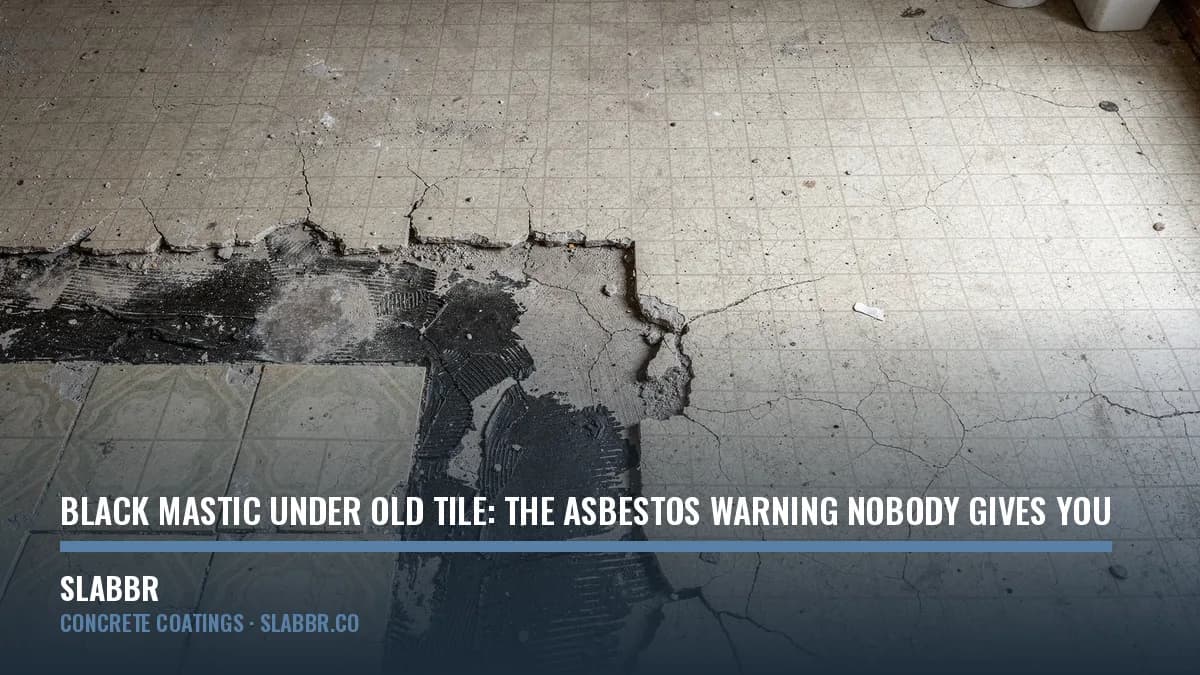
Black mastic is the tar-like cutback adhesive under old vinyl tile, and it sometimes contains asbestos. Intact, it is generally low risk. Grinding it is not. Slabbr stops work and recommends testing by an accredited lab before any floor prep, because diamond grinding is exactly what makes fibers airborne.
What Black Mastic Actually Is
Black mastic is the common name for cutback adhesive, an asphalt-based glue thinned with solvent and troweled onto concrete to hold down resilient flooring. It dries dark brown to black, hard, and brittle. Older material often smells faintly of tar when you scrape it. Installers spread it with a notched trowel, so when the tile comes up you usually see parallel ridges or swirls rather than a smooth film. Some of it stays glued to the back of the tile, and some of it stays on the slab.
It shows up under 9x9 inch vinyl and asphalt tile, under some 12x12 tile, and under old sheet flooring. Homes built before the 1980s are the usual setting. In Dallas-Fort Worth that means older slab-on-grade houses, converted garages, utility rooms, and additions where a previous owner laid tile decades ago and someone later covered it with carpet or laminate. Basements are rarer here than in other parts of the country, but the same tile and the same adhesive turn up in garages and back rooms.
You often meet it for the first time during demo. The tile pops off in cracked pieces, and underneath is a patchy black layer that will not sweep up and will not come off with a scraper without real effort. Some spots look glossy, some look chalky, and some have a faded outline of the tile grid pressed into them. That layer is what this article is about. It is the part people ignore because the tile is the thing they were trying to remove.
Intact Mastic Is One Situation. Grinding It Is Another.
Asbestos causes harm when fibers get into the air and someone breathes them. Fibers bound inside a hard adhesive, pinned under tile, sitting undisturbed on a slab, are not doing that. This is why inspectors so often describe intact flooring materials as low risk and recommend leaving them alone. Nothing about that low risk survives a change in condition. The moment the material is broken, abraded, or turned to dust, the calculus changes, and the person standing over it is the one breathing the result.
Here is the collision almost nobody spells out for homeowners. Every real floor coating job starts with mechanical surface prep. Slabbr grinds every floor with diamond tooling before a single drop of product goes down, because that is the only way to open the concrete and get adhesion. Dry mechanical abrasion is the exact activity that converts a stable, bound material into airborne dust. If asbestos-containing mastic is on that slab, the first step of the coating process is also the worst possible thing you could do to it.
Slabbr runs HEPA dust extraction on every grinder. That system exists to control ordinary concrete dust and keep your house clean. It is not an abatement control, it is not a substitute for containment, negative air, and trained crews, and no honest contractor should offer it as a reason to grind suspect material. If anyone tells you their vacuum makes asbestos-containing mastic safe to grind, that is the moment to stop the conversation and call someone licensed in abatement. Dust control and hazard control are two different jobs done by two different trades.
Nine-by-Nine Tile Is a Clue. A Lab Is the Answer.
The 9x9 inch tile is a well-known age marker. It was widely used in the era when asbestos was common in flooring products, so seeing that size tells you the floor is old enough to be worth checking. It does not tell you the tile contains asbestos, and it tells you even less about the adhesive underneath, which is a separate material tested separately. Tile and mastic can come back with different results from the same square foot of floor. If both are staying in the picture, both get tested.
Appearance runs both directions and neither direction is reliable. A 12x12 tile is not proof of a clean floor. A black adhesive is not proof of a dirty one, because plenty of asphalt-based glues never contained asbestos at all. Color, smell, brittleness, and installation date are all circumstantial. The only way to know what is on your slab is laboratory analysis of a physical sample, typically by polarized light microscopy at an accredited lab. That is a real answer with a document attached to it.
Sampling is itself a disturbance of the material, which is why it should generally be handled by a licensed professional rather than by a homeowner with a chisel. On the rules side, be careful with anything you read online, including this page. Requirements differ for a homeowner working in their own residence versus a contractor working for hire, and Texas administers its own licensing and notification program through the state health department. Confirm what applies to your specific job with a licensed asbestos professional before anyone touches the floor.
What a Responsible Coating Company Does, and What a Red Flag Looks Like
When Slabbr pulls back carpet or laminate and finds old tile or black mastic on a pre-1980s slab, the job stops. We do not grind it. We do not scrape a test patch to see what happens. We do not take the sample ourselves, because that is abatement work and we are a coating company. We tell you what we found, we recommend testing through a licensed professional, and we put your install on hold. The floor gets scheduled after the material is cleared as negative or professionally abated.
The red flag is easy to recognize once you know to watch for it. A crew looks at the black adhesive, shrugs, says it is probably fine or that houses this age are usually clear, and reaches for the grinder. Probably is not a test result. That crew has decided to gamble with the air in your house, and once a slab has been ground dry there is no undoing it. Ask directly what happens if they find mastic, and listen for whether testing is in the answer.
Watch for the encapsulation pitch too. Someone may tell you the coating will just seal the mastic in place, so testing is unnecessary. That answer skips the part that matters, because coatings do not bond to a dirty slab and the crew still has to grind first. It also puts a decision about managing a potential hazard in the hands of a salesperson quoting a floor. Encapsulation, when it is appropriate at all, is a call for a licensed abatement professional to make and document.
Sequencing and Honest Cost Framing
The order of operations is not negotiable, and it protects your money as much as your lungs. Test first. If the result is negative, the floor moves forward like any other prep job. If it is positive, a licensed abatement contractor handles removal or an approved management plan, and clearance comes before any coating crew arrives. Testing and abatement are separate services with separate contracts and separate line items. A coating quote written before you have a lab result is not a real number.
Slabbr will not guess at abatement pricing, and you should be skeptical of anyone who does over the phone. What we can tell you is our own side. Slabbr One is $6 per square foot, Slabbr Prime is $8 with a moisture vapor barrier under the base coat, and Slabbr Ironclad is $10 with that barrier plus two polyaspartic topcoats. On a 440 square foot two-car garage that is $2,650, $3,520, or $4,400. Removing a failed previous coating runs $1.50 per square foot, about $660 on that same garage.
Once the slab is cleared, the install itself is one day. You walk it at 24 hours and park on it at 72. Every build is 100 percent polyaspartic in the base coat and the topcoat, with diamond grinding and HEPA extraction instead of acid etching, a moisture reading before product goes down, crack repair with rigid polymer at no charge, and flake broadcast to refusal. The lifetime residential warranty attaches to the job with no registration card. A 50 percent deposit books the date and the balance is due after you have walked the finished floor.
Get It Tested First. We Will Be Here After.
If you have pulled up old tile and found black adhesive on the slab, do not let anyone grind it and do not grind it yourself. Have it tested by a licensed professional and get a lab result in writing. Once the floor is cleared or professionally abated, call us and we will quote it like any other job: Slabbr One at $6 per square foot, Prime at $8, Ironclad at $10, which is $2,650, $3,520, or $4,400 on a 440 square foot two-car garage. Estimates are free, there are no commissioned salespeople, and there is no travel premium anywhere in DFW. Burleson (469) 849-8338. Celina (903) 243-9525.
Related services
The floors behind this article
Related questions
- How much does it cost to coat a 2-car garage floor?
- Do you grind the floor or acid etch it?
- Will cracks in my slab come back through the coating?
- Can you coat over an existing epoxy floor?
What we guarantee, in writing: the warranty. How install day runs: our process. The standards we prep to: ASTM and ICRI.
Straight answers, real numbers
Keep reading
See your number in about a minute
Pick what we are coating, pick the size, get a price. No home visit needed to see it and no salesperson attached to it.