
September 8, 2026
Does epoxy flooring yellow indoors, or only in direct sunlight?
Yes. Standard epoxy ambers from ultraviolet light, and an open garage door delivers hours of daylight to the first several feet of slab, so the front band yellows while the covered rest does not. Slabbr avoids this by building all three floors in 100% aliphatic polyaspartic, every layer.
Written by the Slabbr crew, installing concrete coatings across North Texas since 2019. About Slabbr
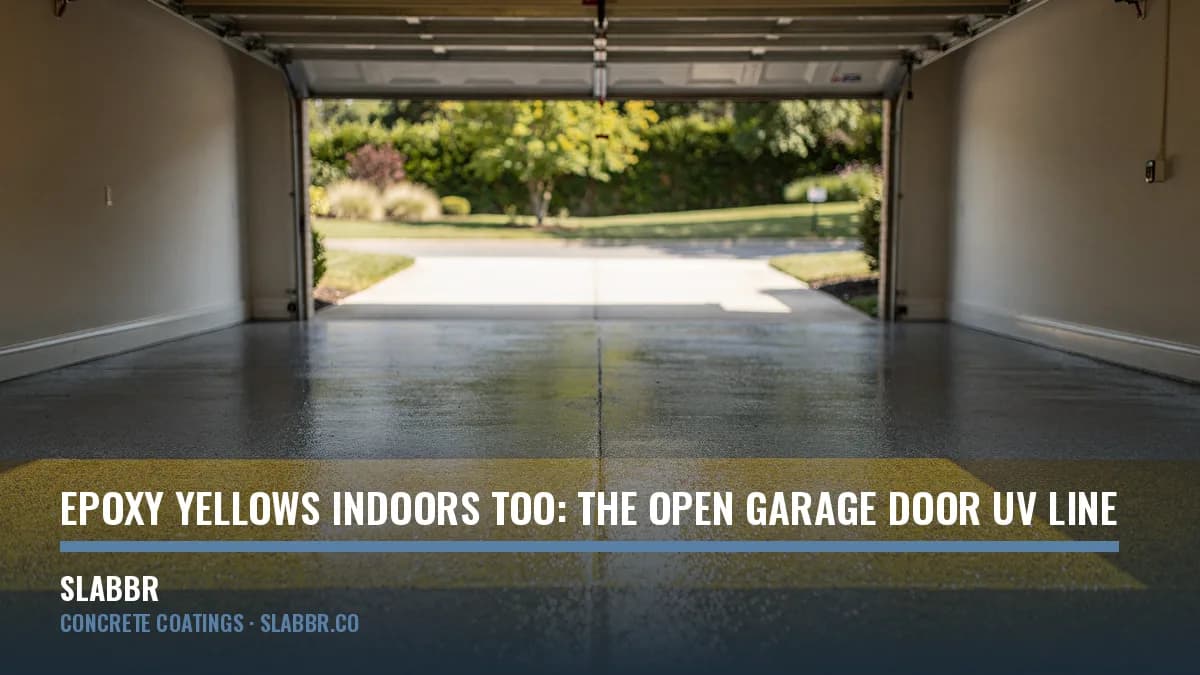
Yes. Standard epoxy ambers from ultraviolet light, and an open garage door delivers hours of daylight to the first several feet of slab, so the front band yellows while the covered rest does not. Slabbr avoids this by building all three floors in 100% aliphatic polyaspartic, every layer.
The Line Across Your Garage Floor Is the Tell
Walk into a Dallas-Fort Worth garage with an epoxy floor that is three or four years old. Look at the first six to ten feet of slab, the part that sits inside the door opening. In a lot of them there is a line. The floor in front of the line reads warmer, a little more amber or tan. The floor behind it still reads close to the color that was installed. Nothing spilled there. Nothing failed there. That band simply got daylight for hours a day while the rest of the slab sat in shade.
That is what an open garage door does. It is not a window. It is a hole in the wall roughly sixteen feet wide and seven feet tall, pointed at the sky. A light concrete driveway bounces a lot of sun back through that opening, and the sun tracks across it all afternoon. Homeowners run the door open while they work, while kids come and go, while the truck cools off. Two hours a day for three years is real exposure on that band and almost none on the rest of the floor.
The reason this reads as a defect rather than aging is the edge. An evenly ambered floor just looks like an older floor. A floor with a hard boundary at the ten foot mark looks like someone used two different products on one slab. Your eye locks onto the transition and will not let go of it. That is why the complaint is almost never the word yellowing. It is that the front of the garage no longer matches the back of the garage. Once a homeowner sees the line, they see it every single time they pull in.
Why Standard Epoxy Ambers and Polyaspartic Does Not
Standard epoxy is built on a bisphenol A backbone. In plain terms, the resin molecules contain aromatic rings, which are flat six carbon structures that happen to absorb ultraviolet light very well. When they absorb it, bonds break, and the fragments that form are yellow. That reaction runs one direction only. No cleaning product, no buffing pad, and no chemical walks it back. Once the color shifts, the color has shifted. Every epoxy sold for garage floors uses this same ring chemistry in some form, at some concentration. Heat and humidity speed the reaction up, which is why North Texas summers push it along faster than a mild climate would.
Aliphatic products are built without those rings. Polyaspartic is an aliphatic polyurea. Its carbon chains are straight or branched instead of ringed, so there is nothing in the molecule tuned to grab UV energy and come apart. That is the entire difference. It is not a coating that shrugs off sunlight because of an additive package. It is a resin that does not contain the part sunlight attacks. UV stabilizers blended into an epoxy slow the reaction down and buy time. They do not remove the aromatic rings that cause it.
Know which word you are being sold. Aromatic polyurea and aromatic polyurethane also amber, and both get marketed as a step up from epoxy. The term that matters on a technical data sheet is aliphatic. If a contractor cannot tell you whether the product going on your slab is aromatic or aliphatic, that is a useful answer about how well they know the material. Slabbr builds with 100% polyaspartic and no epoxy and no fast-set polyurea, so the question has one answer on every job.
The Topcoat Decides UV Stability, Not the Base
UV stability lives in the layer that touches the light. Sunlight has to pass through the topcoat first. If that top layer is aliphatic, it takes the exposure without changing color, and the base coat underneath never sees enough ultraviolet to matter. This is why hybrid builds exist. An epoxy base with a polyaspartic topcoat is a legitimate system, and it holds color at the door line far better than epoxy with an epoxy clear over it. Anyone claiming otherwise is overselling their own product line.
A hybrid is not wrong. It has a different weak point. You now have two chemistries with two rates of expansion and two different moisture tolerances bonded to each other. When a slab pushes water vapor up from below, the epoxy base is the layer that lifts, and the good topcoat comes off still attached to it. Slabbr builds every layer in polyaspartic, base coat and topcoat both, across all three builds. One chemistry through the full thickness means there is no chemistry interface to fail.
Flake helps as well, and that is not a sales line. A full flake broadcast to refusal covers the base coat completely with colored vinyl chips, and those chips carry their own pigment. Even where some color shift happens in the clear above them, the visual result is spread across thousands of flecks instead of reading as one flat sheet of amber. A solid color floor shows every degree of ambering. A heavily flaked floor hides most of it, which is why every Slabbr build broadcasts to refusal.
How to Test What You Already Have
Testing your existing floor takes about a minute and no tools. Slide a toolbox, a floor mat, or a storage tub that has sat in one spot for a year or more. If the coating under it is noticeably lighter than the floor around it, your coating has ambered. That covered patch is your original color, preserved. Do this in the front third of the garage, inside the door opening, because that is where exposure has been concentrated and where the difference shows up first and largest.
Second check. Stand at the back wall in daylight with the door open and look toward the driveway. A soft gradient across the middle of the slab points to ultraviolet exposure. A stripe with a straight edge points to UV plus a shadow line thrown by the door track or the header above it. Blotchy round patches under where a car parks are a different problem. Those are usually hot tire pickup or a chemical stain, and they get fixed differently than a color shift. Color shift is uniform within its band. Staining is not.
Third, ask for the paperwork. Any real coating has a technical data sheet, and that sheet names the resin type. Look for the word aliphatic on the topcoat line. If the installer is long gone, the original invoice usually names the product, and the manufacturer publishes the sheet online. Installers commonly report that big box kits and many one day franchise builds are an epoxy base under an epoxy or aromatic clear, which is exactly the stack most likely to show a door line.
Ambering Is Cosmetic, and Here Is What Fixing It Costs
Be clear about what ambering actually is. It is a color change inside the resin. It is not delamination, it is not a bond failure, and it does not mean the floor is about to peel. An ambered epoxy floor can be tightly bonded, structurally sound, and perfectly usable for years. What it will not do is look the way it looked on install day. If the coating is still tight and you can live with a warmer front section, doing nothing is a defensible choice and costs you zero.
If it does bother you, there are two paths. Recoating means scuffing the existing surface and rolling an aliphatic clear over the top. That locks the current color in place and stops further shift. It does not undo the amber that is already there. You are freezing a floor that already reads warm at the front, and the line stays visible. Anyone telling you a fresh clear coat restores the original color is promising something the chemistry cannot deliver. Recoating buys appearance stability going forward, nothing behind you.
Rebuilding removes the problem instead of sealing it in. Slabbr grinds a failed coating off at $1.50 per square foot, about $660 on a 440 square foot two car garage, then builds new. Slabbr One is $6 per square foot, $2,650 on that garage. Slabbr Prime is $8, $3,520, adding a moisture vapor barrier under the base coat. Slabbr Ironclad is $10, $4,400, with the vapor barrier plus two polyaspartic topcoats. Install takes one day. Walk it at 24 hours, park on it at 72.
Get a Garage Floor That Still Matches at the Door Line
Slabbr builds three ways across Dallas-Fort Worth, all 100% polyaspartic in every layer. Slabbr One is $6 per square foot, Slabbr Prime is $8 with a moisture vapor barrier, and Slabbr Ironclad is $10 with the vapor barrier plus two topcoats. On a 440 square foot two car garage that is $2,650, $3,520, or $4,400. Every build includes diamond grinding with HEPA dust extraction instead of acid etching, a moisture reading before any product goes down, crack repair with rigid polymer at no charge, flake broadcast to refusal, and a lifetime residential warranty attached to the job with no registration card. Removal of a failed coating runs $1.50 per square foot. Estimates are free, there are no commissioned salespeople, and there is no travel premium anywhere in DFW. A 50% deposit books your install date, and the balance is due after the floor is finished and you have walked it. Call Burleson at (469) 849-8338 or Celina at (903) 243-9525.
Related services
The floors behind this article
Related questions
- How much does it cost to coat a 2-car garage floor?
- What is the difference between epoxy and polyaspartic?
- What is hot tire pickup?
- Why is my epoxy garage floor turning yellow?
What we guarantee, in writing: the warranty. How install day runs: our process. The standards we prep to: ASTM and ICRI.
Straight answers, real numbers
Keep reading
See your number in about a minute
Pick what we are coating, pick the size, get a price. No home visit needed to see it and no salesperson attached to it.