
September 9, 2026
What is the difference between polyurea and polyaspartic garage floor coatings?
The difference between polyurea and polyaspartic garage floor coatings is mostly naming. Polyaspartic is a type of polyurea, specifically an aliphatic polyurea made with a polyaspartic ester, so the two are not opposites. In the garage trade, polyurea usually means a fast-set aromatic base coat and polyaspartic means the slower aliphatic topcoat. Slabbr builds every layer in polyaspartic, base coat included.
Written by the Slabbr crew, installing concrete coatings across North Texas since 2019. About Slabbr
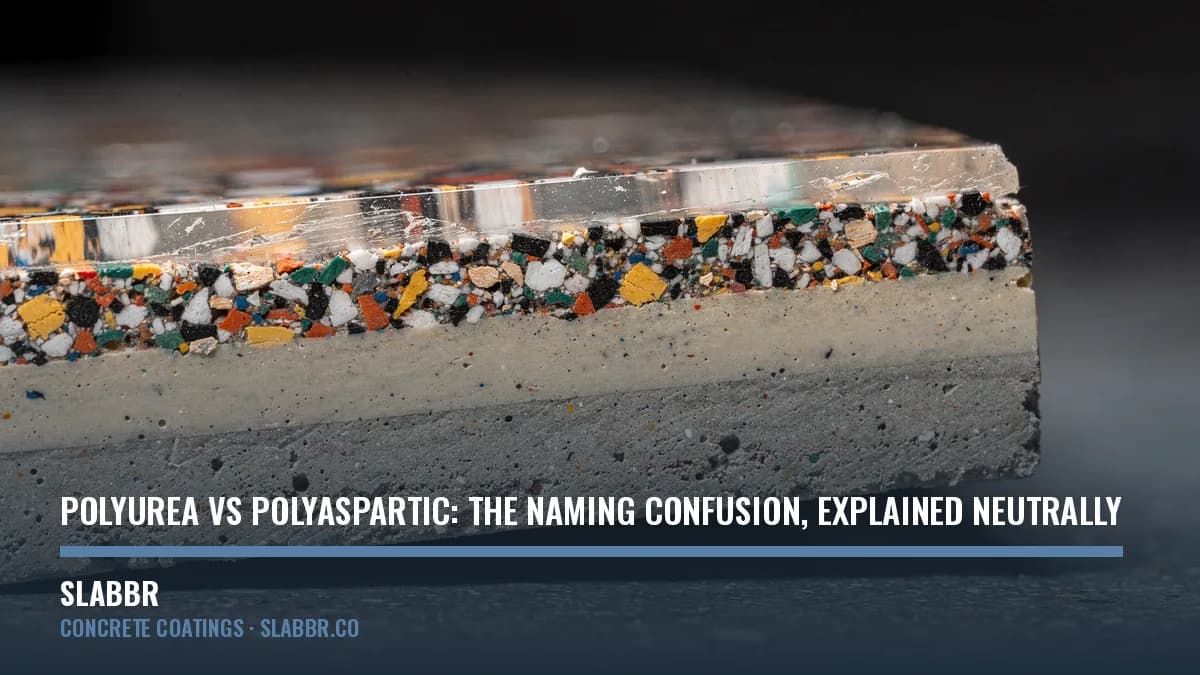
The difference between polyurea and polyaspartic garage floor coatings is mostly naming. Polyaspartic is a type of polyurea, specifically an aliphatic polyurea made with a polyaspartic ester, so the two are not opposites. In the garage trade, polyurea usually means a fast-set aromatic base coat and polyaspartic means the slower aliphatic topcoat. Slabbr builds every layer in polyaspartic, base coat included.
Polyaspartic Is a Polyurea, Which Is Why the Comparison Confuses People
Start with the chemistry, because most of the marketing depends on you not knowing it. Polyurea is a broad family of coatings formed when an isocyanate reacts with an amine. Polyaspartic sits inside that family. It is an aliphatic polyurea made with a polyaspartic ester, which is simply a slower reacting amine. So the phrase polyurea vs polyaspartic sets up a contest between a whole category and one member of that category. That is not a clean either/or. It is closer to asking whether you want fruit or an apple, and the answer depends entirely on which apple.
This matters because two companies can describe the same floor in opposite terms and both can point to a technical data sheet that backs them up. A crew installing an aliphatic polyaspartic can honestly call the floor a polyurea. A crew installing a fast-set aromatic polyurea base under a polyaspartic topcoat can honestly call the floor polyaspartic. Neither statement is a lie. Both statements leave out the part that changes how the floor gets built, how much time the crew has to build it, and how the surface looks in five years of Texas sun.
The result is a page of search results where nearly every article is written by a company that sells one of the two. A shop that installs polyaspartic argues polyurea is the cheap version. A shop that installs a fast-set base argues polyaspartic is a marketing word. Each side is accurate on its own terms and neither one is inventing anything. Almost none of them open by saying the two words overlap, because the overlap makes the comparison far less useful as a sales tool. That gap is the reason this page exists.
What the Garage Floor Trade Actually Means by Each Word
Strip away the chemistry and look at how installers use the words on a real driveway. When a garage floor company says polyurea, it almost always means a fast-set aromatic polyurea base coat. Working time on those products often lands in the 5 to 20 minute range, depending on the specific product and the slab temperature that morning. When the same company says polyaspartic, it almost always means the slower aliphatic version used as the topcoat. Both products are polyurea by chemistry. On a slab, in a crew's hands, they behave nothing alike.
Aromatic and aliphatic describe the molecular backbone, and the practical difference is sunlight. Aromatic chemistry ambers under UV. It shifts toward yellow, and on a light gray or white floor that shift is easy to see. Aliphatic chemistry does not do this. That single fact is why the top layer of nearly every quality garage floor is aliphatic, including floors sold under the polyurea name. If a company tells you the floor is polyurea and also promises it will not yellow, the topcoat is aliphatic. The word polyurea is doing double duty in that sentence.
So the honest version of the question is not polyurea or polyaspartic. It is which chemistry is in the base coat, which chemistry is in the topcoat, and how many coats there are in total. A two layer system can be aromatic under aliphatic, aliphatic under aliphatic, or epoxy under aliphatic. All three get sold as one day floors. All three can carry the word polyurea or polyaspartic across the top of the estimate. The label on the front page tells you almost nothing until somebody breaks it out layer by layer.
What a 5 to 20 Minute Working Time Does to the Install
A short working time is not a defect by itself. It is a constraint, and constraints press hardest on the parts of a job that are easiest to shortcut. The first thing that gets compressed is prep. Diamond grinding, dust extraction, crack repair, and a moisture reading all have to be finished before any product opens, because once the base coat is mixed the clock runs hard. A crew working against a 10 minute pot life on a hot slab has a real incentive to call the grind good enough and start pouring.
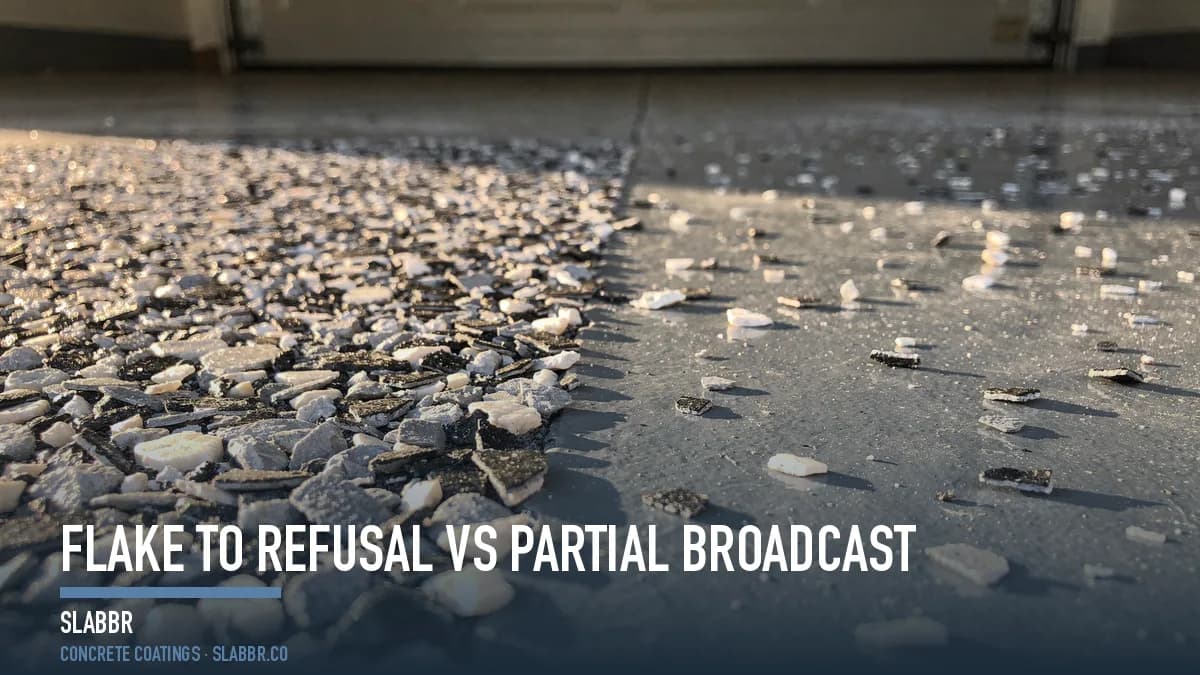
The second thing that gets compressed is the flake broadcast. Flake is thrown into wet base coat, and it should go in until the surface refuses to take any more. That is what broadcast to refusal means. Done right it gives you a full flake bed, even color, and a thicker overall build. If the base coat starts skinning over at 10 minutes, a crew cannot finish a refusal broadcast across an entire two car garage before the surface stops accepting flake. The last section poured ends up thinner than the first section poured.
Neither problem shows up on install day. A light broadcast still looks like a flake floor once the topcoat goes over it and the sheen evens everything out. It shows up two or three years later as bare spots where the flake bed was thin, or as base coat color reading through in raking light near the door. That is the practical reason to ask about working time. Not because fast is bad, but because working time sets a hard limit on what a crew can physically finish in one continuous pass across 440 square feet.
Where Fast-Set Polyurea Genuinely Earns Its Place
Fast-set aromatic polyurea is a real product with real advantages, and pretending otherwise would be the same kind of sales talk this page is arguing against. It cures fast in cold conditions, and that is not a small thing. Freezer floors and cold storage rooms are the clearest case. Those spaces cannot be warmed to a comfortable coating temperature without shutting the operation down and moving product, and a coating that sets in minutes at low temperature is the difference between a one shift job and a week of lost inventory.
It also wins on turnaround anywhere downtime costs money by the hour. A warehouse aisle, a loading dock, a fleet repair bay. If the operation has to reopen in twelve hours, a fast-set base is the right tool and a slower aliphatic base is the wrong one. Those floors are usually indoors under artificial light, often in dark colors, and frequently under equipment. The ambering that rules aromatic chemistry out of a sunlit residential garage matters far less in a room that never sees direct sun.
A home garage in Dallas Fort Worth is a different problem with different constraints. The door opens most days. Sun hits the front third of the slab directly for hours. The floor is usually a light or mid tone flake blend, which is exactly the color range where ambering becomes visible. And almost nobody needs a two car garage back in service in eight hours. The pressure that makes fast-set chemistry valuable in a freezer is simply not present in a residential garage, while the tradeoffs that come with it still are.
The One Question That Cuts Through the Marketing
Ask for the base coat chemistry in writing, layer by layer. Not the system name. Not the brand name. The question is this: what product goes down as the base coat, is it aromatic or aliphatic, and what is its working time? Then ask the same three things about the topcoat, and ask how many topcoats there are. A contractor who builds a careful floor can answer all of that in one text message. A contractor who answers by repeating the system name has still told you something worth knowing.
Most one day floors sold in this market are hybrids. An epoxy or fast-set polyurea base under a polyaspartic topcoat. That is not inherently fraud, and it is worth saying plainly. Hybrid systems can perform well, and plenty of crews install them carefully with proper grinding and a full broadcast. The problem is narrower than fraud. The label hides which layer is which, and the layer buyers ask about the least is usually the one carrying the flake and doing the bonding. Getting it in writing costs nothing and makes two estimates comparable.
Slabbr made a choice here, and the reason matters more than the claim. All three Slabbr builds are 100% polyaspartic in every layer, base coat and topcoat, with no epoxy and no fast-set polyurea anywhere in the system. The longer working time of an aliphatic base gives the crew room to finish diamond grinding with HEPA extraction, take a moisture reading, repair cracks with rigid polymer, and broadcast flake to refusal across the whole floor rather than the first section only. It is still a one day install. Walk it at 24 hours, park on it at 72.
Get the Layers in Writing Before You Sign Anything
Slabbr publishes pricing so you can compare it against whatever else you are quoted. Slabbr One is $6 per square foot. Slabbr Prime is $8 and adds a moisture vapor barrier under the base coat. Slabbr Ironclad is $10 and adds that barrier plus two polyaspartic topcoats. On a 440 square foot two-car garage that comes to $2,650, $3,520, or $4,400. Removing a failed coating runs $1.50 per square foot, about $660 on the same garage. Every build includes diamond grinding with HEPA dust extraction, a moisture reading, free crack repair, flake broadcast to refusal, and a lifetime residential warranty that attaches to the job with no registration card. Estimates are free, there are no commissioned salespeople, and there is no travel premium anywhere in DFW. A 50% deposit books the install, and the balance is due only after the floor is finished and you have walked it. Call Burleson at (469) 849-8338 or Celina at (903) 243-9525.
Related services
The floors behind this article
Related questions
- What is the difference between epoxy and polyaspartic?
- Do you grind the floor or acid etch it?
- Will cracks in my slab come back through the coating?
- Do I have to empty my garage?
What we guarantee, in writing: the warranty. How install day runs: our process. The standards we prep to: ASTM and ICRI.
Straight answers, real numbers
Keep reading
See your number in about a minute
Pick what we are coating, pick the size, get a price. No home visit needed to see it and no salesperson attached to it.