
September 10, 2026
Should garage floor expansion joints be filled before a coating goes down?
No. Slabbr honors garage floor expansion and control joints instead of filling them rigid, because concrete moves and a locked joint just relocates the crack into your coating a few feet away. The polyaspartic coating runs into the joint, and the joint line stays visible by design.
Written by the Slabbr crew, installing concrete coatings across North Texas since 2019. About Slabbr
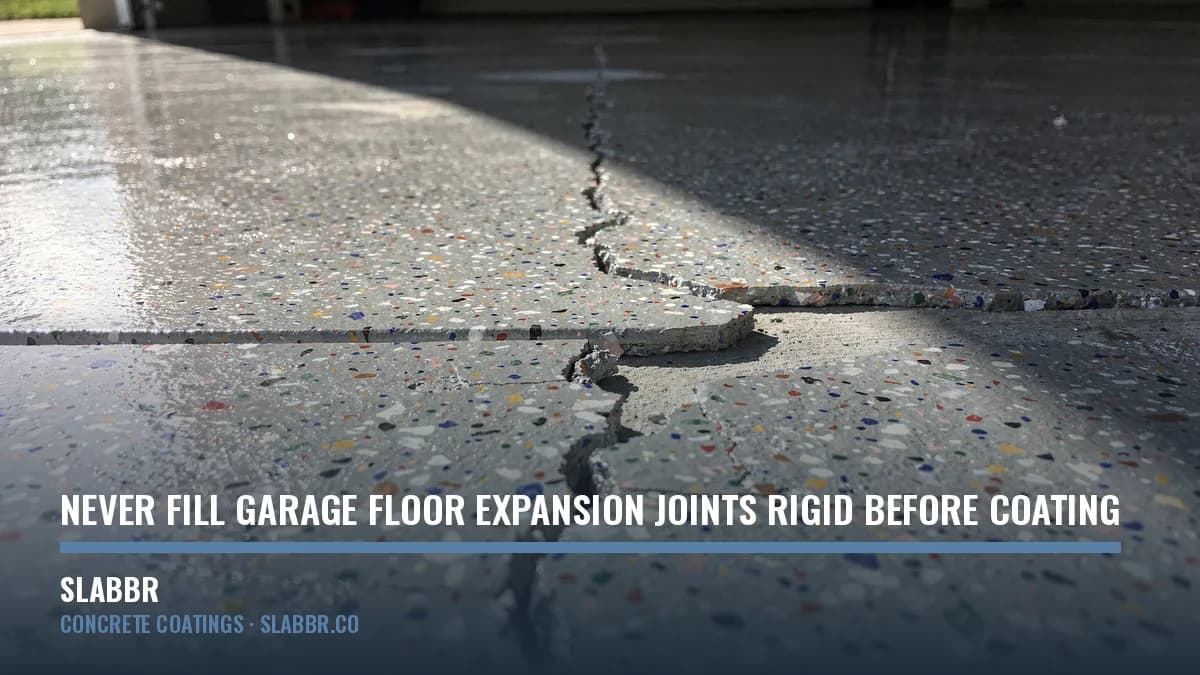
No. Slabbr honors garage floor expansion and control joints instead of filling them rigid, because concrete moves and a locked joint just relocates the crack into your coating a few feet away. The polyaspartic coating runs into the joint, and the joint line stays visible by design.
A Control Joint And An Expansion Joint Are Not The Same Line
Concrete moves. A slab in Dallas-Fort Worth gains and loses width every day as the temperature swings and the soil under it dries out and swells back. Two kinds of lines in your floor exist because of that. A control joint, also called a contraction joint, is a deliberate weak line, usually saw-cut within a day of the pour or tooled into the wet surface. It tells the slab where to crack as the concrete shrinks. The crack forms under that line instead of wandering across the middle of your garage.
An expansion joint is a different animal. It is a full-depth separation between two independent sections of concrete. You usually find one at the garage door line where the slab meets the apron or driveway, and sometimes where the floor meets a foundation wall or a stem wall. It exists so those sections can move against each other without carrying load across the gap. There is often a compressible filler board sitting inside it. That gap is structural. It is not a cosmetic groove that somebody forgot to finish.
The answer to should I fill it is different for each one. A control joint is shallow, usually cut about a quarter of the slab depth, and it takes a small amount of movement. An expansion joint carries real movement and has to stay free. Any contractor who talks about the joints as one single category, without asking which line sits at your door and which lines are saw cuts, is not thinking about your slab. Ask which is which before anyone writes you a price.
What Actually Happens When You Fill A Joint Rigid
Here is the part most DIY pages skip. Filling a joint with rigid epoxy or a hard polymer, then rolling coating straight over the top, does not stop the slab from moving. Nothing you pour into a groove stops a concrete slab. The movement is still there. All you have done is glue the two sides together and tell the concrete to find a new place to relieve the stress. That new place is wherever the slab happens to be weakest, which is almost never where you would have picked.
In practice the crack shows up one to three feet away from the buried joint, running at an angle across an otherwise clean floor. It telegraphs through the coating as a jagged line, because a crack that forms on its own has no straight edge to follow. Compare that to a saw cut, which is a straight line with square shoulders. One of those reads as a floor built correctly. The other reads as a failure. You traded a clean line you chose for a ragged line the slab chose for you.
Timing makes it worse. The rigid fill usually looks perfect on install day and stays that way through the first season. DFW then puts the slab through 100 degree summers and freezing January mornings, and the crack tends to surface months later, long after the crew has gone and the photos are already on somebody's website. That is why joint treatment belongs in the conversation before the deposit is paid, not in a warranty claim in year two.
Honoring The Joint Is Standard, And A Visible Line Is Not A Defect
Honoring the joint is standard practice and it is simple. The coating runs down into the joint and back up the other side, so the concrete is fully protected and nothing can wick into the cut. The joint line stays visible as a shallow groove. On a deeper cut, the installer re-cuts or rakes the line once the coating has cured so the groove keeps a clean edge. The floor is still continuous and still sealed. The movement path is still open. Nothing that needs to move has been glued shut.
A visible joint line is what a correctly built floor looks like. Homeowners sometimes read it as unfinished work, mostly because the marketing photos online are shot at angles that hide it. Walk through any warehouse, any auto shop, any grocery aisle with a coated or polished floor and you will see the joint pattern right there. Those floors were specified by people who deal with slab movement for a living. The line is the design doing its job. Flake and a satin topcoat make it read as intentional rather than as a flaw.
There is a practical benefit too. When a joint stays open and coated and the slab does move, the coating works at that line instead of tearing somewhere out in the open field. Polyaspartic has more give than epoxy, which helps, but no coating chemistry outmuscles a moving slab. Keeping the movement at the joint means that if you ever do need attention out there, it is on a straight line you can address on its own without disturbing the rest of the floor.
When Semi-Rigid Filler Earns Its Place, And Why The Door Line Never Does
Semi-rigid filler is a real product with a real job. In a warehouse or a manufacturing bay, hard wheels cross joints thousands of times a day. Forklift wheels hammer the joint shoulders and chip the concrete edges until a clean cut widens into a pothole. A semi-rigid polyurea or epoxy filler, installed flush and shaved level, supports those edges and absorbs the impact. That is a load-support decision made for traffic a residential garage never sees. It is not a decision made to hide a line.
Your car does not do that. Passenger tires are soft, the wheel loads are low, and a tire crosses a joint a few times a day at walking speed. Paying for joint fill in a two-car garage buys you a look you may not want and load support you definitely do not need, and it hands you the movement risk on top. If a shop offers semi-rigid fill on a house, ask what wheel load they are supporting. Most of the time there is no answer to that question.
The expansion joint at the door line is the one to protect above all others. That gap separates your garage slab from the apron or driveway, which sits on different soil, takes direct sun, and moves on its own schedule. Lock it solid with rigid filler and you have tied together two slabs that were built to move independently. If anything goes in that gap, it should be a flexible sealant over backer rod, something that compresses and stretches, never a hard filler troweled flush and coated over.
What To Ask An Installer, And What A One-Piece Look Really Promises
Ask a few direct questions. Which lines in my floor are control joints and which are expansion joints. Are you filling them or honoring them. If you are filling, what product, what is its elongation, and what happens when the slab moves. Who pays if a crack shows up next to a filled joint in year two. Then get the answers written on the estimate. A shop that treats joints as an engineering question will answer in about a minute. A shop that treats them as a styling question will change the subject.
Be careful with a quote that promises a one-piece look across every joint in the floor. What that promise actually commits to is filling the joints and burying them. That is not a finish upgrade. It is a decision to move future cracking off the joint line and out into the open field of your floor, sold to you as a feature. The install-day photo will look great. The install-day photo is not the warranty, and the slab has not moved yet when that photo is taken.
One more distinction that gets blurred, sometimes on purpose. Slabbr repairs cracks with rigid polymer at no charge on every build, because a crack is a failed piece of concrete that has already done its moving and needs to be made solid again. A joint is the opposite of that. It is a working line that has to stay free. Crack repair and joint treatment are two different jobs using two different materials, and a shop that describes them in one breath is not being careful with your floor.
Get A Straight Answer About Your Joints Before Anyone Grinds
Slabbr builds three ways, 100% polyaspartic in every layer, base coat and topcoat, with no epoxy and no fast-set polyurea. Slabbr One is $6 per square foot. Slabbr Prime is $8 and adds a moisture vapor barrier under the base coat. Slabbr Ironclad is $10 with that barrier plus two polyaspartic topcoats. A 440 square foot two-car garage runs $2,650, $3,520 or $4,400. Removal of a failed coating is $1.50 per square foot, about $660 on that same garage. Every build includes diamond grinding with HEPA dust extraction, never acid etching, a moisture reading before any product goes down, crack repair with rigid polymer at no charge, and flake broadcast to refusal. One day install, walk it at 24 hours, park on it at 72 hours, with a lifetime residential warranty that attaches to the job and needs no registration card. The estimate is free, there are no commissioned salespeople, and there is no travel premium anywhere in DFW. A 50% deposit books the install, and the balance is due only after the floor is finished and you have walked it. Call Burleson at (469) 849-8338 or Celina at (903) 243-9525.
Related services
The floors behind this article
Related questions
- Do you grind the floor or acid etch it?
- What is hot tire pickup?
- Why is my epoxy garage floor turning yellow?
- Will cracks in my slab come back through the coating?
What we guarantee, in writing: the warranty. How install day runs: our process. The standards we prep to: ASTM and ICRI.
Straight answers, real numbers
Keep reading


See your number in about a minute
Pick what we are coating, pick the size, get a price. No home visit needed to see it and no salesperson attached to it.