
September 5, 2026
What is the difference between full flake broadcast and partial broadcast on a garage floor?
Flake to refusal means chips are broadcast into the wet base coat until the floor will not absorb another one. Partial broadcast stops at 60 to 80 percent and leaves base coat showing. Both photograph the same. Slabbr broadcasts to refusal on all three builds, at $6, $8, and $10 per square foot.
Written by the Slabbr crew, installing concrete coatings across North Texas since 2019. About Slabbr
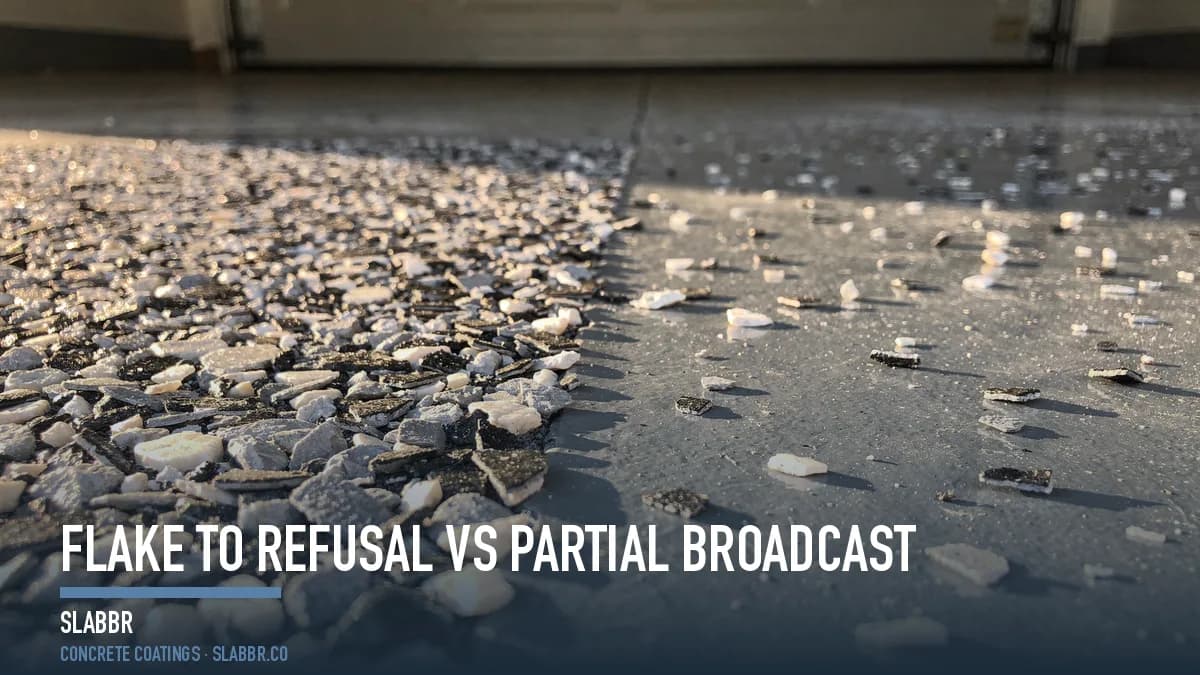
Flake to refusal means chips are broadcast into the wet base coat until the floor will not absorb another one. Partial broadcast stops at 60 to 80 percent and leaves base coat showing. Both photograph the same. Slabbr broadcasts to refusal on all three builds, at $6, $8, and $10 per square foot.
What broadcasting to refusal actually means
A flake floor is not paint with sprinkles on top. The chips are structural. They go into the wet base coat while it is still open, the excess gets scraped and vacuumed off the next morning, and the topcoat locks the whole thing down. That middle layer is a real part of the system thickness, not decoration, which is why how much flake went down matters more than what color it was.
To refusal is the point where the wet base coat has taken every chip it can hold. Throw more and they sit loose on top with nothing to bond into. Reaching that point takes two or three passes across the same section and a crew willing to keep walking the floor until the gray is gone. When it is done right the surface reads as one continuous color instead of colored dots scattered over a gray field.
Partial broadcast stops well short of that. The installer walks the slab once, throws chips in a pattern, and quits when coverage looks acceptable from standing height. On day one it photographs fine. Base coat is showing between the chips, but base coat is usually tinted gray or tan, and gray gaps between gray flakes disappear in a phone picture taken from six feet up. That is the whole reason the practice survives. The customer cannot see it at handoff, and by the time it shows, the crew is three hundred jobs down the road.
Why a partial broadcast is cheaper for the crew installing it
Three costs drop at once, which is why this is the most common quiet cut in the trade. Flake is a real material line. A full broadcast commonly runs 25 to 50 pounds of chip per 100 square feet depending on chip size, so 110 to 220 pounds on a 440 square foot two car garage. A thin broadcast often lands under 15 pounds per 100 square feet. That is more than half the material gone off a line item almost nobody itemizes.
Labor drops next. A fully saturated floor is left rough and loaded with loose chip, and every bit of that excess has to be scraped and vacuumed before the topcoat goes on. That is real time on hands and knees the following morning. A light broadcast barely needs scraping at all, which takes a half day out of the job. Then the topcoat drops too, because a dense flake surface has more texture and more surface area and simply drinks more clear than a smooth one does.
Add those three together and a crew can shave a meaningful amount off its cost on your garage without changing a single word on the quote. Nothing in a normal bid exposes it. The quote says flake floor, the photos show a flake floor, the price sits inside the normal range, and the part that got cut is invisible until the second or third summer. This is exactly the kind of cut that makes two honest-looking bids on the same garage mean completely different things.
What a thin broadcast costs you
Build thickness goes first. The flake layer is a meaningful share of the total system, so cutting the flake cuts the floor. A partial broadcast garage is measurably thinner than a full one built from the identical products by the identical crew, and thickness is what absorbs the hit when a jack stand comes down hard or a socket drops off the bench. Same materials, same warranty language, less floor.
The wear surface goes second, and this is the one that shows. In a saturated system the topcoat is protecting a dense bed of chip, so as the clear wears in the tire path it exposes more flake underneath and the floor keeps looking like itself. In a thin system the topcoat is sitting directly on base coat across much of the slab. When it wears through there, you get a dull gray patch where the color used to be, and there is nothing to buff back. The only repair is recoating.
Two more losses are easy to miss at signing. Chip texture is most of what keeps a garage floor from turning slick when a wet truck pulls in on a January morning, so the smooth gaps in a thin broadcast are the exact spots where someone slips. And a saturated flake surface is what hides patched cracks, cold joints, and color variation in the concrete underneath. Thin it out and the repair map telegraphs through, which is the most common complaint on floors that were otherwise installed correctly.
The working time problem that forces a thin broadcast
A partial broadcast is not always a pricing decision. Sometimes the chemistry chose it. Some companies build on a fast set polyurea base coat because it kicks quickly, which is convenient for scheduling and makes a fast turnaround easy to advertise. The tradeoff is working time. Once that base coat starts to gel the window for pushing chips into it is closed, and anything thrown after that is sitting on a skinned surface with nothing to grab. It comes up later under a scraper.
That short window squeezes the two steps that should never be rushed. Prep gets compressed, because grinding time is eating the pot life of a batch that is already mixed and already curing on the floor. Broadcast gets compressed, because there is no time to walk the slab a second and third time and actually saturate it. The floor cures fast and looks finished on schedule, and it is thinner than it should be in both directions at once.
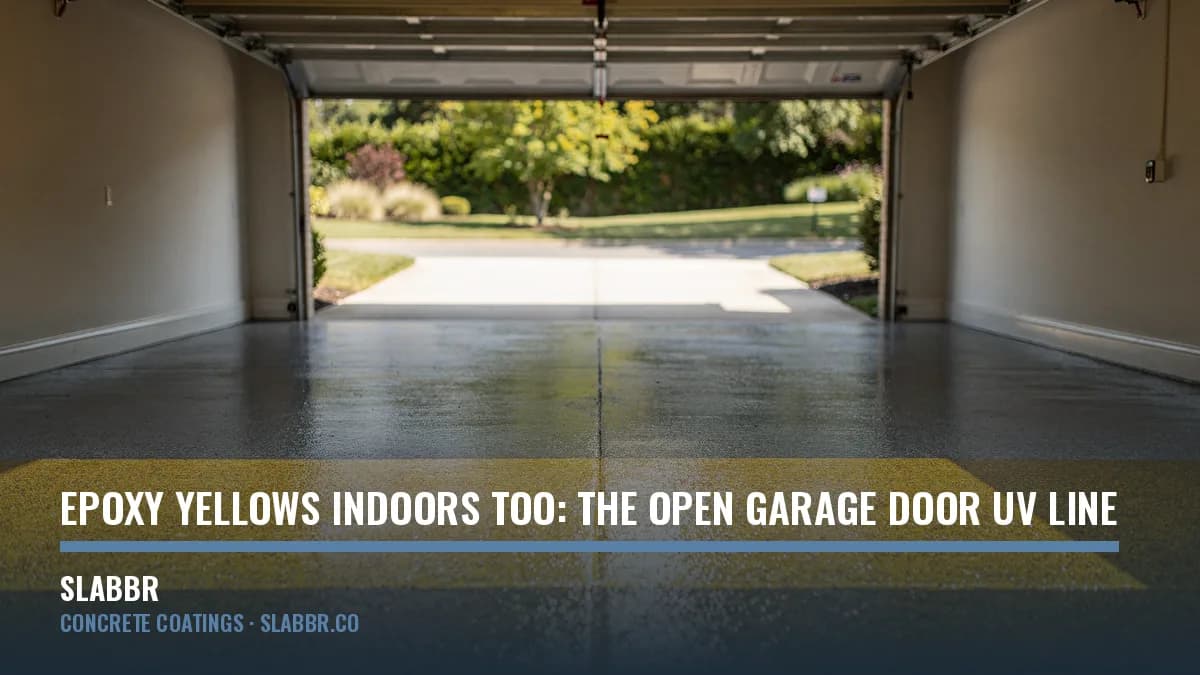
Straight epoxy creates the opposite problem rather than solving it. Working time is generous, but cure time runs into days, so the job stretches across several visits with the slab sitting exposed to dust and traffic between coats. Epoxy also ambers under the UV coming through your garage door, has low elongation so it splits where the slab moves, and softens under hot tires, which is where hot tire pickup comes from in the first place. Slabbr builds on polyaspartic base coats with enough open time to grind properly and broadcast to refusal, and still finishes in a single day. That is a formulation choice, not a scheduling trick.
How to check a bid before you sign, and what Slabbr charges
You cannot judge flake coverage off a marketing photo, but four checks will tell you almost everything. Ask for pounds of flake per 100 square feet, in writing. A crew that broadcasts to refusal knows its number and will hand it over. A crew that does not will change the subject to warranty length. Anything under 20 pounds per 100 square feet is a partial broadcast no matter what it gets called on the quote. Then ask what happens to the excess, because a full broadcast produces a pile of loose chip that has to be scraped and vacuumed the next morning. If nobody mentions scraping, nobody is broadcasting to refusal.
The other two are visual. Ask for a photo taken low and along the floor near a wall or the garage door, because raking light throws shadows into the gaps that a standing photo flattens out, and edges and corners are where a thin throw shows first. And put your hand on a finished floor if the company has one you can visit. A saturated flake surface has continuous texture from wall to wall. A thin one has smooth patches between rough ones, and you will feel the difference in about three seconds.
Slabbr publishes what each build costs and what is in it. One is $6 per square foot, which is $2,650 on a 440 square foot two car garage. Prime is $8, which is $3,520, and adds a moisture vapor barrier under the base coat. Ironclad is $10, which is $4,400, and carries the moisture vapor barrier plus two polyaspartic topcoats for shops and heavy use. Every one of the three includes diamond grinding with HEPA extraction, a moisture read before any product goes down, and crack repair with rigid polymer at no charge. Flake is broadcast to refusal on all three. There is no Slabbr build with a thin broadcast, because coverage is not the line we compete on.
Ask every bid on your counter for pounds of flake per 100 square feet
The companies that answer that question are the ones worth quoting. Slabbr publishes three rates and holds them: One at $6 per square foot, Prime at $8, Ironclad at $10, which is $2,650, $3,520, and $4,400 on a 440 square foot two car garage. Diamond grinding, a moisture read, crack repair, and flake broadcast to refusal are in all three, with a lifetime residential warranty that attaches to the job. One day install, walk it at 24 hours, park on it at 72. The estimate is free and nothing is due until the floor is in and you have walked it. Burleson (469) 849-8338. Celina (903) 243-9525.
Related services
The floors behind this article
Related questions
- How much does it cost to coat a 2-car garage floor?
- Can you coat over an existing epoxy floor?
- Is the estimate free, and do you use salespeople?
- What does the warranty actually cover?
What we guarantee, in writing: the warranty. How install day runs: our process. The standards we prep to: ASTM and ICRI.
Straight answers, real numbers
Keep reading
See your number in about a minute
Pick what we are coating, pick the size, get a price. No home visit needed to see it and no salesperson attached to it.