
September 3, 2026
Should I hire a franchise or a local garage floor coating company?
A franchise and a local garage floor coating company can both install a good floor. Franchises buy you scheduling capacity, documented process, and financing. Local shops buy you direct accountability. What matters is who answers the phone in year three, and whether the price is published. Slabbr publishes three builds at $6, $8, and $10 per square foot, and the warranty attaches to the job.
Written by the Slabbr crew, installing concrete coatings across North Texas since 2019. About Slabbr
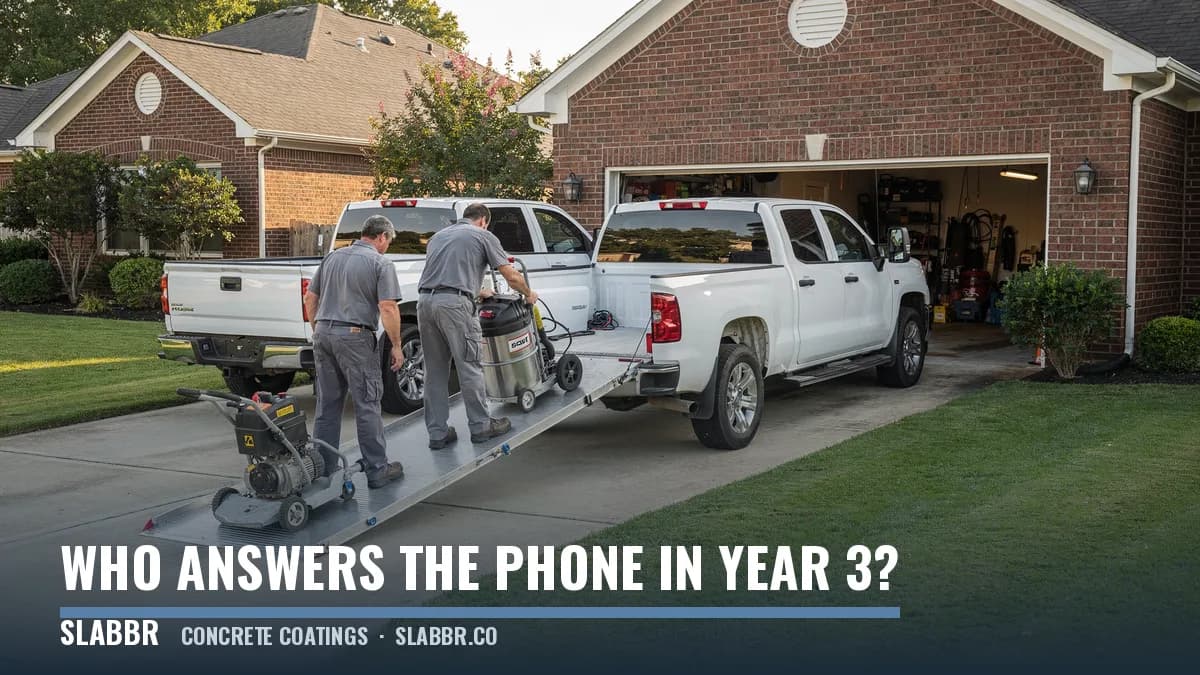
A franchise and a local garage floor coating company can both install a good floor. Franchises buy you scheduling capacity, documented process, and financing. Local shops buy you direct accountability. What matters is who answers the phone in year three, and whether the price is published. Slabbr publishes three builds at $6, $8, and $10 per square foot, and the warranty attaches to the job.
How a garage floor coating franchise is actually built
A franchised coating company is two businesses stacked on top of each other. There is the brand, which sells territories, and there is the operator, who bought one. The operator pays an upfront fee to own your zip code, then pays a royalty on every dollar of revenue, then pays into a national advertising fund on top of that. Franchise disclosure documents across the home services category describe royalties in the mid single digits and ad fund contributions of a point or two, with entry fees well into five figures. None of that money buys grinder time on your slab. It buys the name and the lead flow that comes with the name.
The lead flow usually starts at a call center. You dial a number you saw on a truck or a search ad, and the person who answers is not in your city and will not be at your house. They book an in-home appointment and route it to whoever owns the territory. A commissioned salesperson arrives with a sample board, a tablet, and a price that is good today. That person is paid on closed revenue, not on how the floor looks in year four. The crew that grinds your concrete is a separate group of people you have not met and cannot question before you sign the contract.
What the franchise overhead adds to your quote, and what it genuinely buys
Add it up from the operator's side. Royalty, national ad fund, call center, sales commission, and the cost of carrying the territory all come out of the same job. Commissioned in-home selling pays on closed contract value, and users routinely report that the first number on the tablet drops by several hundred dollars the moment they say they want to think about it. A price with that much room in it was not built from your square footage. It was built from what the room would bear. The physical inputs do not move that way. The grinder, the HEPA vacuum, the polyaspartic, the flake, and the two technicians cost about the same in every zip code in DFW.
Now the fair part. Franchises are good at three things small shops struggle with. Scheduling capacity is real. A territory running four or five crews can put you on the calendar next week in October, when every independent in the metroplex is booked into November. Process documents are real. A written prep spec, a moisture protocol, and a crew checklist mean the eighth job of the month gets the same steps as the first, which is exactly what falls apart when a two-truck shop gets busy. Financing is real. Many territories carry consumer lending that spreads four thousand dollars over eighteen months. If you need any of those three, say so out loud and shop on it.
So the honest framing is not that one model is good and the other is bad. It is that you are paying a premium for capacity and paperwork, and you should know what the premium is before you decide whether it is worth it. The only way to know is to make every company quote you a rate per square foot on a named build. A bundled package price with a name and an expiring discount is designed to keep that arithmetic away from you. Once you have the rate, the comparison takes about ninety seconds and you can stop guessing what you are actually buying.
What happens to a lifetime warranty when the territory changes hands
Read the warranty document, not the yard sign. Across the category, coating warranties are typically written by the local operating entity, not by the national brand, even when the brand name sits at the top of the page. That distinction does not matter while the operator is open. It matters a great deal when the operator sells the territory, closes it, or loses the franchise agreement for missing system standards. Territories change hands. Franchisees exit. When that happens your claim goes to a new owner who did not do your job, did not price your job, and did not collect your money. Some new owners honor prior work for reputation reasons. Some do not, and nothing in the document requires them to.
Then read the exclusions. Warranties across the category typically exclude moisture coming up through the slab, hot tire pickup, chemical staining, impact damage, and anything the document calls owner abuse. Many exclude labor and cover only the material, which means a covered failure still costs you a full teardown and reinstall out of pocket. Many require a registration card returned within thirty days. Many require a transfer fee and paperwork when you sell the house. Every one of those clauses is a place where a claim can quietly die. Ask for the full document before the salesperson leaves. If the answer is that the office will email it later, you do not have a warranty yet.
What local shops get wrong, and the questions that work on both
Local does not automatically mean better. The common failure mode for an independent is undercapitalization. One truck, one grinder, no bench depth, and a bank balance that cannot survive a slow February. Ask any coating company in DFW how many failed floors they have torn out, and a good share of them came off slabs a local guy coated three years ago with a rented machine. The specific shortcuts to watch for are acid etching instead of diamond grinding, no moisture reading before the first coat goes down, no HEPA extraction so your garage and attic fill with concrete dust, and one thin roll of product priced to win the job rather than to last a decade.
The other local failure is quieter. The company simply stops answering. No bankruptcy filing, no letter, just a number that rings out and a voicemail box that is full. A lifetime warranty from a business with no shop address, no second location, and no crew beyond the owner is a promise underwritten by one person staying interested in the trade. That is not a reason to rule out local work. It is a reason to ask what the business looks like underneath the truck wrap. How many years under the same name. How many trucks. Where the shop is. Who picks up the phone at four on a Friday in August.
Here are the questions that work on either model, and they are the same questions. Who owns this company, and will that person or the crew lead be on my job. How do you profile the slab, and if the answer is anything other than diamond grinding, stop there. Do you take a moisture reading before you coat, and what do you do if it reads high. Send me the full warranty document today, including exclusions and any registration or transfer requirement. What is your price per square foot for this exact build. And the year three question. If I call this number in September of 2029, who answers, and is it still the same company name.
What it costs, and why we publish the number
Here is our price, in public, before anyone comes to your house. A standard two-car garage is 440 square feet. Slabbr One runs $6 per square foot, which is $2,650. Slabbr Prime runs $8 per square foot, which is $3,520, and it adds a moisture vapor barrier and a flexible polyaspartic base. Slabbr Ironclad runs $10 per square foot, which is $4,400, and it is full polyaspartic. If a failed coating is on the slab now, removal is $1.50 per square foot, about $660 on a two-car garage, and it adds a half day to the schedule. Those numbers do not change because you hesitated, and they do not change because you live in Celina instead of Burleson.
Compare that to the quote structure you get from a commissioned in-home visit. You will not know the rate per square foot. You will get one bundled number for a package with a name, a discount that expires when the salesperson stands up, and a payment quoted per month instead of a total. That is a pricing method built to hide the rate, and it works. When you do not know what a square foot costs, you cannot tell whether you are paying for polyaspartic or for a royalty. Ask every company you talk to for the rate per square foot on the exact build they are quoting. Any shop that will not give you that number has told you something.
What that price includes, on every job, at every tier. Diamond grinding with HEPA extraction. We never acid etch. A moisture read before a drop of product goes down. Crack repair with rigid polymer at no charge. One day install, walk it at 24 hours, park on it at 72. A lifetime residential warranty that attaches to the job, not to a registration card and not to a transfer form. Sell the house and the warranty stays with the floor. The balance is not due until the floor is installed and you have walked it. There is no commissioned salesperson in that transaction and no travel premium anywhere in DFW.
Get a real number before anyone sits down at your kitchen table
Call Burleson at (469) 849-8338 or Celina at (903) 243-9525. We walk your slab, take a moisture reading, and quote off the same published rates everyone else sees. Slabbr One is $6 per square foot, Prime is $8, Ironclad is $10, which comes to $2,650, $3,520, and $4,400 on a 440 square foot two-car garage. The estimate is free, and nothing is due until the floor is installed and you have walked it.
Related services
The floors behind this article
Related questions
- How much does it cost to coat a 2-car garage floor?
- Can you coat over an existing epoxy floor?
- Is the estimate free, and do you use salespeople?
- What does the warranty actually cover?
What we guarantee, in writing: the warranty. How install day runs: our process. The standards we prep to: ASTM and ICRI.
Straight answers, real numbers
Keep reading
See your number in about a minute
Pick what we are coating, pick the size, get a price. No home visit needed to see it and no salesperson attached to it.