
September 1, 2026
Should I pay a deposit for a garage floor coating?
Nothing should be due before your garage floor is installed. Slabbr takes no deposit at all. You pay after the coating is down, cured enough to walk, and you have walked it yourself. A deposit moves the risk from the coating company onto you, before a single grinder touches your slab.
Written by the Slabbr crew, installing concrete coatings across North Texas since 2019. About Slabbr
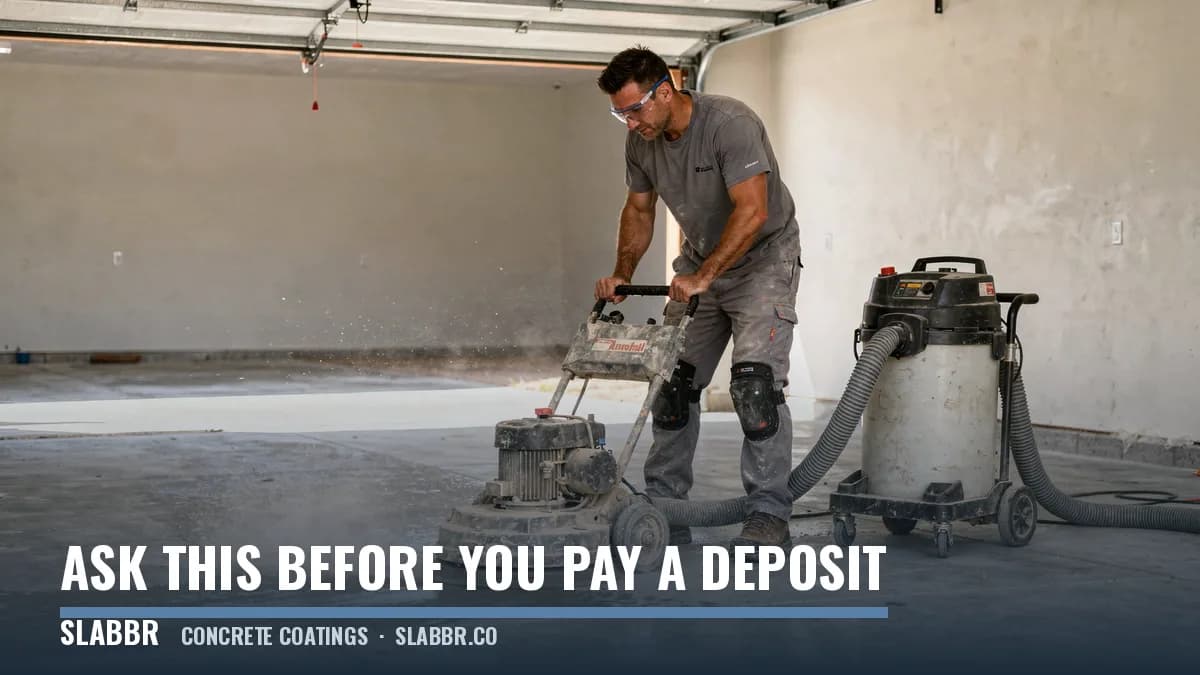
Nothing should be due before your garage floor is installed. Slabbr takes no deposit at all. You pay after the coating is down, cured enough to walk, and you have walked it yourself. A deposit moves the risk from the coating company onto you, before a single grinder touches your slab.
A Deposit Moves the Risk Off the Contractor and Onto You
Before a deposit, the coating company carries the risk. They have to show up, grind your slab, read the moisture, and put down a floor you accept. After a deposit, you carry it. You are the one holding a receipt and waiting. If the crew reschedules twice, you wait. If the number on the final invoice does not match the number on the estimate, you argue from behind. If the phone stops getting answered, you are chasing your own money instead of shopping for a floor. Nothing about the coating itself changed. The only thing that changed is who is exposed when the job goes sideways.
Deposits have honest uses in construction. A cabinet shop ordering custom doors, a fabricator cutting stone to your template, a fence crew staging cedar in your driveway. Those are real costs a contractor eats before install day, tied to something built for your address and useless anywhere else. Garage coatings are not that trade. Coating resins and vinyl flake are stock inventory that a crew pulls off a shelf, whatever the chemistry on the label. Nothing gets cut, milled, or special ordered for a 440 square foot garage. When a coating company asks for money before the truck arrives, it is funding cash flow, not buying material for your floor.
That makes the deposit question a screening tool, and a polite one. You are not accusing anyone of anything by asking how the money works. You are finding out how the company thinks about risk. A crew that trusts its prep, its product, and its own schedule can wait one day to get paid. A company that needs your card number before the grinder comes off the trailer is telling you something about its book of business. So ask it plainly. How much is due today, how much on install day, and what happens to my money if you cancel or push the date. Then notice whether the answer comes back in numbers or in reassurance.
What a Normal Deposit Looks Like and What an Abnormal One Looks Like
Across general contracting, consumer guidance commonly describes anything up to about a third of the job as a defensible deposit, and a few states cap it outright. California and Nevada limit residential deposits to ten percent or one thousand dollars, whichever is smaller. Texas has no general cap of that kind, so in DFW the number is whatever the contract says. For garage coatings specifically, the honest benchmark is far lower than the general trades benchmark, because the material cost is stock and the labor is one day. Half down on a one day job with shelf inventory is not a deposit. It is a loan from you at zero percent.
A few patterns should stop you cold. A deposit demanded in cash, by wire, or by payment app. A deposit that is only refundable at the company's discretion, or not refundable at all. A deposit tied to a discount that disappears if you sleep on it. A deposit collected by a salesperson who will never be on your driveway again. And the most common one in this trade, the price that is good today only, which exists to keep you from calling anyone else. Industry reports and consumer protection groups describe that same-day close as the signature of a sales operation rather than a crew.
Two protections are worth knowing before you sign anything at your kitchen table. Federal rules give buyers three business days to cancel many contracts signed in the home, and that window is easy to lose if the sales rep is vague about when it started. And pay by credit card or check, never cash, because a card issuer can dispute a charge and a bank can trace a check. If a company will only take a deposit in a form that leaves no trail, you have learned everything you need to know without asking a second question.
The Four Questions That Expose a Prep Shortcut
Ask how the slab gets prepped, and listen for one word. Grind, or etch. Diamond grinding with vacuum extraction opens the concrete profile mechanically so the coating locks in. Acid etching pours a chemical on the surface, rinses it, and hopes. Etching is faster, cheaper, and the single most common reason a coating peels in sheets two summers later. The top ranking guides in this category agree on that point, and one of them calls buffer etching the mark of an amateur. Slabbr diamond grinds with HEPA extraction on every job, residential and commercial, with no exceptions and no acid. If a company hedges on this question, you have your answer.
Ask whether they read moisture before they coat, and ask what happens if the reading is high. Concrete moves water. A slab pushing vapor up from below will lift a coating no matter how good the product is, and moisture failure is one of the exclusions that quietly appears in warranties across this category. Slabbr takes a moisture read before anything goes down, and the Prime build carries a moisture vapor barrier for slabs that need one. Then ask about mil thickness, which is the question nobody on the first page of Google mentions. Thickness is what you are buying. A company that cannot state a number is selling you a color.
Ask what happens to your cracks and who pays for it. Every quote sounds similar until the crew is on site and cracks become a change order. Get the answer before install day, in writing, with a dollar figure or the word included next to it. Slabbr repairs cracks with rigid polymer at no charge as part of the job. Then ask the last one, which is what a redo costs if this coating fails. Slabbr removes a failed coating at one dollar fifty per square foot, about six hundred sixty dollars on a 440 square foot two car garage, and it adds roughly a half day. A company that has never priced its own do-over has not thought about failure.
Warranty, Writing, and What To Do When They Will Not Put It On Paper
There is one warranty question that separates real coverage from a brochure. Does the warranty attach to the job, or does it attach to me. If it registers to you, it usually means a card to mail, a portal to sign up on, a window you can miss, and transfer paperwork if you sell the house. Every one of those steps is a place a claim can die on a technicality years later. The Slabbr lifetime residential warranty attaches to the job. No registration card, no portal, no transfer paperwork when the house changes hands. Ask any company you are considering to state which of those two it is, out loud, before money moves.
Then get the number on paper. The written price should name the build, the square footage, the prep method, the mil thickness, whether crack repair is included, the cure timeline, and the total. Slabbr installs in one day, you walk it at 24 hours, and you park on it at 72. Those are the details that turn a friendly driveway conversation into something you can hold someone to. Ask one more question while the rep is standing there. What happens to this price if I say no today. If the price only survives while the rep is in your driveway, it was never the price. It was a lever.
If a company will not put an answer in writing, do not argue and do not negotiate. Say that you need it in an email before you can sign, then stop talking. A crew that intends to do the work will type four lines and hit send, because none of it costs them anything. A sales operation will explain why the system does not allow that, or offer to write it after the deposit clears, or start talking about the discount again. You have not lost anything at that point. You have gotten a free look at how the company will behave on the day something actually goes wrong on your floor.
What a Garage Floor Coating Actually Costs, Published Before You Ask
Here is the part the top ranking pages in this category leave out entirely. Neither of them names a dollar figure anywhere, and neither states any payment term. Slabbr publishes both. A two car garage is 440 square feet. The One build runs six dollars per square foot, which is two thousand six hundred fifty dollars installed. Prime runs eight dollars per square foot, or three thousand five hundred twenty dollars, and adds a moisture vapor barrier over a flexible polyaspartic base. Ironclad runs ten dollars per square foot, or four thousand four hundred dollars, and is full polyaspartic. Every one of them includes diamond grinding, a moisture read, and crack repair.
Published pricing is not a marketing choice. It is the thing that makes a deposit unnecessary. When the price is on the website before a rep knocks, there is no discount to expire, no reason to close you tonight, and no number that changes between the driveway and the invoice. The estimate is free. There are no commissioned salespeople, so nobody in this company earns more by talking you into Ironclad when One is the right build for your slab. There is no travel premium anywhere in DFW, from Burleson to Celina and everywhere between, so your address does not move the number either.
Which brings it back to the deposit. Slabbr takes 50% to book the install and not a dollar more until the coating is installed and you have walked the floor yourself. That is the counter-offer to hold every other bid against, and it costs you nothing to put it in front of them. Ask the next company what is due today. Ask them to email you the price, the prep method, the mil thickness, and whether the warranty registers or attaches. Then compare the two answers side by side. The floor you end up with is usually decided by that conversation, long before anyone starts a grinder.
Get a Free Estimate With Nothing Due Up Front
Slabbr publishes the price before you call. A 440 square foot two car garage is 2,650 dollars for One, 3,520 for Prime, 4,400 for Ironclad, with diamond grinding, a moisture read, and crack repair included on all three. 50% deposit to book, no commissioned salespeople, no travel premium in DFW. The balance is not due until the floor is installed and you have walked it. Call Burleson at (469) 849-8338 or Celina at (903) 243-9525.
Related services
The floors behind this article
Related questions
- How much does it cost to coat a 2-car garage floor?
- Can you coat over an existing epoxy floor?
- Is the estimate free, and do you use salespeople?
- What does the warranty actually cover?
What we guarantee, in writing: the warranty. How install day runs: our process. The standards we prep to: ASTM and ICRI.
Straight answers, real numbers
Keep reading
See your number in about a minute
Pick what we are coating, pick the size, get a price. No home visit needed to see it and no salesperson attached to it.