
September 4, 2026
Is $4,000 a fair price for an epoxy garage floor?
Whether $4,000 is a fair price for an epoxy garage floor comes down to square footage. Divide the quote by your real square footage. $4,000 on a 440 square foot two car garage is $9.09 per square foot, which sits inside the normal professional range. Slabbr publishes $6, $8, and $10 per square foot, so $4,000 is fair only if it buys diamond grinding, a moisture read, and a lifetime warranty.
Written by the Slabbr crew, installing concrete coatings across North Texas since 2019. About Slabbr
Whether $4,000 is a fair price for an epoxy garage floor comes down to square footage. Divide the quote by your real square footage. $4,000 on a 440 square foot two car garage is $9.09 per square foot, which sits inside the normal professional range. Slabbr publishes $6, $8, and $10 per square foot, so $4,000 is fair only if it buys diamond grinding, a moisture read, and a lifetime warranty.
Divide the quote by your actual square footage first
Every quote you get is a lump sum, and lump sums cannot be compared to each other. Convert yours to dollars per square foot before you do anything else. Take the total, divide it by the measured floor area, and write the answer down. A $4,000 quote on a 440 square foot two car garage is $9.09 per square foot. The same $4,000 on a 576 square foot two car garage is $6.94. On a tight 380 square foot garage it is $10.53. One number, three very different prices. Until you run that division you are guessing, and so is anyone you ask.
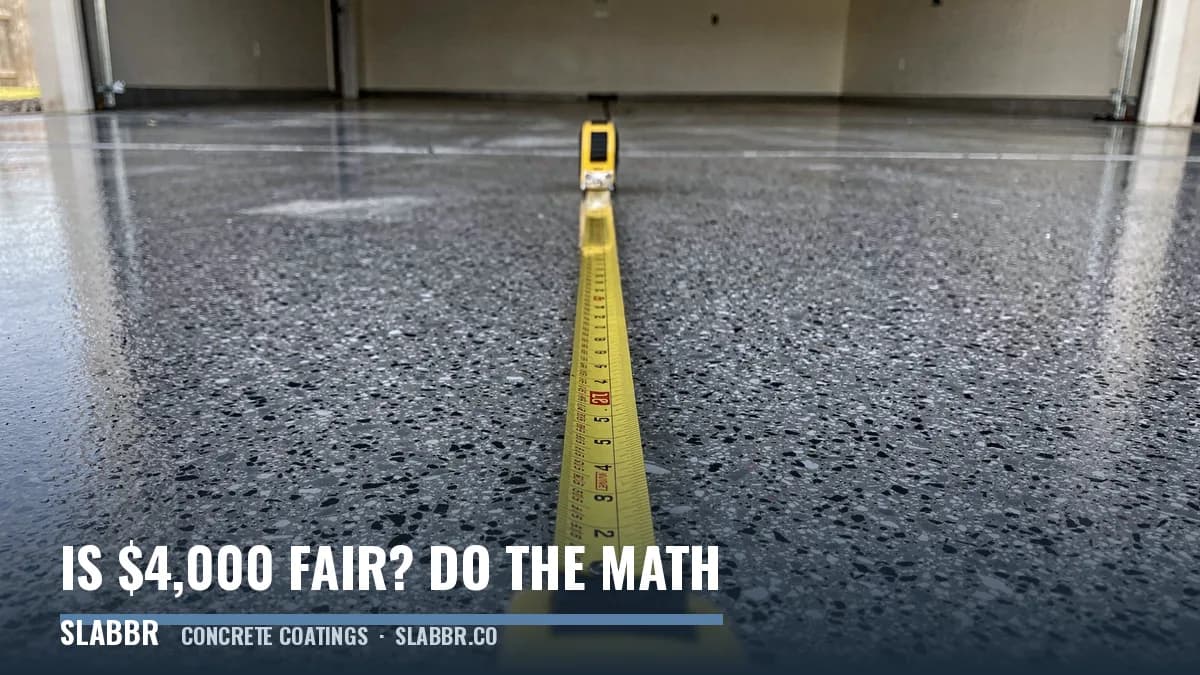
Measure it yourself with a tape. Go wall to wall at the widest points, multiply length by width, and round to the nearest ten square feet. Do not subtract for the water heater or the workbench unless there is a framed wall around it, because the crew still has to grind and coat up to the edge. Then ask each contractor what square footage they used in their bid. If their figure is noticeably larger than yours, the price per square foot they are quoting you is not the price per square foot you are actually paying.
Do this for every bid on your counter. Two quotes at $3,900 and $4,300 look close until you learn that one crew measured 400 square feet and the other measured 520. That works out to $9.75 versus $8.27 per square foot, which means the cheaper looking bid is actually the more expensive floor by a wide margin. Most homeowners never catch that, because nobody tells them to run the division. Dollars per square foot is the only unit that lets you set three quotes side by side and see which one is high, which one is normal, and which one is low enough to worry about.
The honest market range for a professional flake floor
National cost guides put installed epoxy anywhere from $3 to $12 per square foot. That spread is four times wide, which makes it useless for judging a specific quote. The bottom of it is not a professional floor. It is a big box kit, or an etch and roll job where somebody pressure washed the slab, poured acid on it, and rolled a thin color coat over the top. The top of it is usually metallic, quartz broadcast, or a padded number. The band where real grind and flake work actually lives is roughly $6 to $12 per square foot installed, and contractor pages around Dallas and Fort Worth commonly quote $4,000 to $5,500 for a two car garage.
So $9.09 per square foot lands inside that band. That is the honest answer to whether $4,000 is fair on a standard two car garage. It is not a rip off on its face and it is not a bargain either. It sits right in the middle of what a properly prepped, fully broadcast flake floor costs in this market, which is why the number alone does not settle the question either way. Anyone who tells you $4,000 is outrageous without asking your square footage first is guessing. Anyone who calls it a steal is selling you something. The useful question is not whether the total is high. It is what the total covers.
Price per square foot only sets the outer bounds. Inside that band, two crews can charge you the same $9.09 and hand you floors that behave completely differently three summers from now. One holds color and stays bonded. The other lifts at the door line where the hot tires sit. Both were priced fairly by the standard every cost guide on the internet uses. What separates them is not the total on the last page. It is the six line items underneath it, and most quotes in this trade are written in a way that keeps those items off the page entirely.
The same $4,000 buys two very different floors
A fair $4,000 looks like this. The crew shows up with a diamond grinder running HEPA extraction and opens the pores of the concrete across the entire slab, including the corners and the apron. They take a moisture reading before any product touches the floor. They chase the cracks, cut them out, and fill them with rigid polymer. They broadcast flake to refusal so the color is full and even instead of speckled. They top it with a polyaspartic that will not amber under the sunlight coming through your garage door. They finish in one day, you walk on it in 24 hours, you park on it in 72, and the warranty stays with the floor.
A bad $4,000 looks like this. Somebody pressure washes the slab, etches it with acid, and lets it dry in the humidity. No moisture reading, so nobody knows whether vapor is pushing up through the slab. Cracks get skimmed instead of cut and filled, so they telegraph back through in a year. Flake goes down light to stretch the bag. The topcoat is a water based epoxy that yellows and goes brittle. Then you wait five to seven days to park, and the warranty is a certificate with a registration card, a transfer fee, and an exclusion for hot tire pickup, which is the exact failure the coating is supposed to prevent.
Both of those crews wrote $4,000 on a piece of paper. Both of them used the word epoxy. Both of them showed you the same photo of a gray and black flake floor. One of those floors is still tight and flat in ten years. The other one starts lifting at the door line in the second August, and by then the crew that installed it has changed its business name. The dollar figure did not tell you which one you were buying, because the dollar figure cannot. The line items underneath it can, and they are the part you have to ask for.
The six line items that decide which floor you get
Prep is number one and it is not close. Ask whether the slab gets diamond ground or acid etched. Grinding removes the sealed surface layer and gives the coating a profile to bite into. Acid etch is a chemical rinse that leaves residue behind and cannot touch a slab that was power troweled hard. Etching is cheaper, faster, and the single most common reason a coating peels. Number two is the moisture read. Concrete on grade moves water vapor upward, and if that vapor has nowhere to go it pushes the coating off the slab in sheets. A crew that will not test before coating is guessing on your slab.
Number three is chemistry. Straight epoxy is rigid and it ambers in sunlight. Polyaspartic stays flexible, cures fast, and holds color. A quote that says only the word epoxy is not telling you what is going on the floor. Number four is mil thickness. A full flake broadcast to refusal with a clear topcoat builds several times thicker than a rolled color coat, and thickness is what survives a hot tire, a dropped socket, and a jack stand. If the quote does not state a build, ask for it in writing before you sign.
Number five is crack repair. Some contractors price it separately after the grind, which means your $4,000 is not really $4,000. Ask whether crack repair is included or billed as a change order, and get the answer before the crew is standing in your driveway. Number six is warranty terms. Almost every warranty in this category has an escape hatch. Ask three questions. Does it require a registration card. Does it survive a sale of the house. Does it exclude hot tire pickup and delamination. Warranties across the category typically exclude the failures that actually happen.
What Slabbr charges, and when $4,000 is genuinely too low
Slabbr publishes three prices and does not move them. One is $6 per square foot, which is $2,650 on a 440 square foot two car garage. Prime is $8 per square foot, $3,520, and adds a moisture vapor barrier and a flexible polyaspartic base. Ironclad is $10 per square foot, $4,400, and is full polyaspartic. So a $4,000 quote on a two car garage sits between Prime and Ironclad. Every one of those three includes diamond grinding with HEPA extraction, a moisture read before coating, and crack repair with rigid polymer at no charge. Slabbr never acid etches. Not on the cheap build, not on any build.
The warranty is a lifetime residential warranty that attaches to the job. No registration card. No transfer paperwork. If you sell the house, it goes with the floor. The estimate is free, there are no commissioned salespeople, there is no travel premium anywhere in DFW, and nothing is due until the floor is installed and you have walked it. If a coating already failed on your slab, removal runs $1.50 per square foot, about $660 on a two car garage, and it adds roughly half a day. That number is worth remembering, because it is what a bad $4,000 costs you on top of the $4,000.
Now the other direction. $4,000 is too low when the floor is too big for it. On a 750 square foot three car garage that is $5.33 per square foot. On a 900 square foot slab it is $4.44. Neither number covers grinding, a real broadcast, and a polyaspartic topcoat, so something quietly got removed to hit it. Usually it is the grind. Sometimes it is the flake density. Sometimes it is the second coat. $4,000 is also too low on a slab that needs a failed coating stripped first, because that is $660 of labor before the new floor starts. When a quote comes in under the range, ask what came out of it.
Run your own quote against a published number
Slabbr publishes three prices per square foot and holds them. One at $6, which is $2,650 on a 440 square foot two car garage. Prime at $8, $3,520. Ironclad at $10, $4,400. Every build includes diamond grinding, a moisture read, and free crack repair, with a lifetime warranty attached to the job. The balance is not due until the floor is in and you have walked it. Burleson (469) 849-8338. Celina (903) 243-9525.
Related services
The floors behind this article
Related questions
- How much does it cost to coat a 2-car garage floor?
- Can you coat over an existing epoxy floor?
- Is the estimate free, and do you use salespeople?
- What does the warranty actually cover?
What we guarantee, in writing: the warranty. How install day runs: our process. The standards we prep to: ASTM and ICRI.
Straight answers, real numbers
Keep reading
See your number in about a minute
Pick what we are coating, pick the size, get a price. No home visit needed to see it and no salesperson attached to it.