
September 2, 2026
Whose lifetime does a lifetime garage floor warranty actually cover?
A lifetime garage floor warranty can mean three different things: the life of the coating, the life of your ownership, or the life of the company. Slabbr writes a lifetime residential warranty that attaches to the job, not to your name, so it survives a sale with no registration card and no transfer paperwork.
Written by the Slabbr crew, installing concrete coatings across North Texas since 2019. About Slabbr
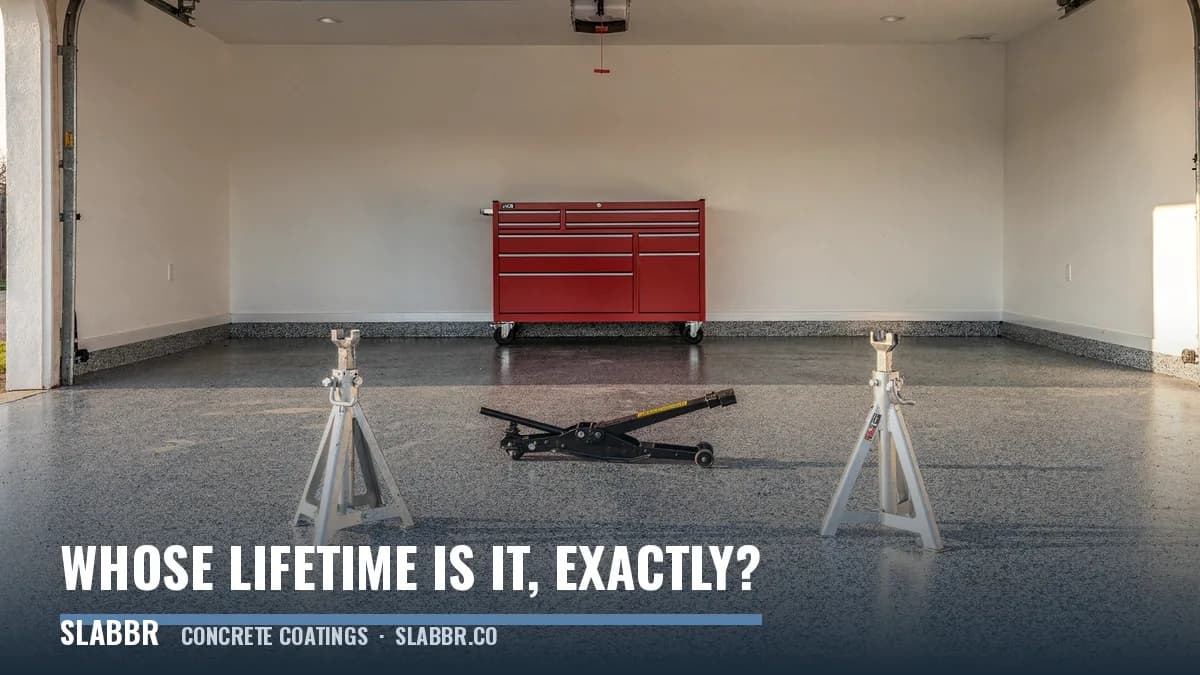
A lifetime garage floor warranty can mean three different things: the life of the coating, the life of your ownership, or the life of the company. Slabbr writes a lifetime residential warranty that attaches to the job, not to your name, so it survives a sale with no registration card and no transfer paperwork.
Lifetime Means Three Different Things in This Trade
Read three garage floor quotes in DFW and all three will say lifetime warranty. The word is doing different work on each one. In this trade it carries three separate meanings, and the quote almost never tells you which one you are getting. The first is the lifetime of the product, meaning the coating is covered until it fails in a way the manufacturer has defined as failure. The second is the lifetime of your ownership, meaning coverage ends the day you sign closing papers on the house. The third is the lifetime of the company, meaning coverage ends when the company does. Only the first one is a promise about your floor.
Product lifetime is the version most buyers assume they are getting. It says the coating will stay bonded and will not peel, chalk, or delaminate under normal residential use, for as long as that floor exists. It is the strongest of the three and the least common in writing. Ownership lifetime is the version most often written down. Warranties across the category commonly use a phrase like for as long as the original purchaser owns the home, which sounds generous in a showroom and reads very differently in year six when you are listing the house. The floor did not change. The coverage just ended.
Company lifetime is the version nobody writes down, because no business puts a clause in its own contract saying coverage stops if we close. It is a real limit anyway. A warranty is a promise from a legal entity, and the promise cannot outlive the entity that made it. Industry commentary on one day coating outfits describes short operating lives and frequent rebranding under new company names, which is the same warranty ending under a different mechanism. When you compare two lifetime warranties, you are really comparing which of these three definitions each company is quietly using.
The Transfer Question: What Happens When You Sell the House
Ask one question and most of the fog clears. If I sell this house in four years, does the new owner call you and get the floor fixed, yes or no. There are only two answers, and they correspond to two ways a warranty can be written. A name based warranty attaches to you, the original purchaser. It follows your name, and it dies at closing. A job based warranty attaches to the work, meaning the slab, the address, and the record of what was installed. It does not care who owns the house. The Slabbr lifetime residential warranty attaches to the job.
The difference shows up twice, and both times it costs you. It costs you when you sell, because a coated garage floor with live coverage is a line you can point to on a disclosure sheet and a name based warranty gives you nothing to point at. It costs the buyer later, when the floor lifts near the door and the company that installed it explains that coverage ended at the closing table. Nothing about the concrete changed. The only thing that changed was whose name sits on the invoice, which is a strange thing for a floor to care about.
Watch for the middle ground too. Some written warranties in the category allow a transfer but cap it, with a one time transfer only, a fee, a filing window measured in days after closing, or a shortened term that replaces the lifetime language once the house changes hands. A capped transfer is honest and workable as long as you know the cap before you buy. What you cannot do is take the word transferable off a website and assume it means unlimited. Ask for the sentence in the contract that describes the transfer, and read that sentence, not the headline above it.
Why Registration Requirements Exist
Plenty of coating companies ask you to register your warranty. It arrives as a card in the folder, a serial number stamped somewhere on the floor, or an online form to complete within a set number of days after install. The stated reason is record keeping, and that reason is legitimate. A company with several crews and a few hundred jobs a year needs to tie a phone call in 2031 back to a specific slab, a specific batch of material, and a specific install date. Registration is one way to build that record, and there is nothing wrong with it on its own.
The part worth understanding is what registration does to the contract. A registration requirement turns coverage into something conditional. If the paperwork is a condition and the paperwork never gets filed, the claim can be closed without anyone driving out to look at your concrete. That makes an unfiled form the cheapest denial available, because it does not require arguing about moisture, prep, or wear. So ask the direct version: is registration a condition of coverage, or is it only how you keep records, and what happens to my coverage if I never register at all.
Slabbr does not use a registration card and does not use transfer paperwork. The install record and the invoice are the coverage, and the coverage attaches to the job. Keep the invoice anyway, because it is the fastest way to establish which build went down and when. When you do call, a photo of the problem area and the date it started is usually all we need to schedule a look. Note that this section is about the paperwork shaped ways coverage disappears. The physical exclusions, meaning the specific kinds of damage a warranty will not pay for, are a separate list and worth reading separately before you sign anything.
When the Installing Company Sells, Rebrands, or Closes
A warranty is only as durable as the business behind it. If the company dissolves, sells its assets, or reopens next spring under a new name and a new LLC, the piece of paper in your folder points at an entity that no longer answers the phone. Industry reports describe this as a common pattern in the one day coating business, and the timing is what makes it sting. Adhesion problems tend to show up years after install, which is exactly the window in which a short lived installer has already gone quiet. The coverage does not get denied. It just has nobody left to honor it.
Two structures behave differently here. With a franchise, the warranty is usually performed by the local franchisee who did your floor, not by the national brand whose logo is on the truck, so a local owner exiting the system can take your coverage with them. Ask the brand directly what happens to existing customers when a franchise location closes, and get the answer in writing. Separately, a manufacturer material warranty may survive the installer, but material warranties typically pay for material only. Labor is most of the cost of a redo, so a surviving material warranty rarely covers what the redo actually costs.
Three questions sort this out fast. How long has this exact legal entity operated under this exact name, and has it operated under any other name before. Who physically performs a warranty repair, the company I paid or somebody else. And does the coverage pay labor or only material. A company that answers all three without hedging, publishes its prices, and preps the same way on every job is easier to evaluate than one that sells you the word lifetime and asks you to trust the rest. Slabbr runs two shops in DFW, Burleson and Celina, and the same crews do the warranty work.
What a Lifetime Warranty Costs, and What a Void One Costs
Slabbr publishes prices, which is the fastest way to tell whether the warranty behind them is priced honestly. A standard two car garage is 440 square feet. The One build runs $6 per square foot, or $2,650. Prime runs $8 per square foot, or $3,520, and adds a moisture vapor barrier over a flexible polyaspartic base. Ironclad runs $10 per square foot, or $4,400, and is full polyaspartic. Every build gets diamond grinding with HEPA extraction, never acid etch. Every job gets a moisture read before any coating goes down, and crack repair with rigid polymer at no charge.
Now price the other side. If a lifetime warranty turns out to be name based, unregistered, or attached to a company that closed, you are not out a service call. You are buying the floor again. Removing a failed coating runs $1.50 per square foot, about $660 on a 440 square foot garage, and it adds a half day to the schedule. Add the new floor on top of that. A void warranty on a $3,520 Prime floor is a four thousand dollar problem the day it surfaces, which is why the definition of the word lifetime is worth ten minutes of your time before you sign.
The prep is what the warranty is written around. Grinding opens the concrete so the base coat has something mechanical to hold, and a moisture read tells you whether vapor coming up through the slab will push a coating off later. Skip either one and the coating fails on a schedule, warranty or no warranty. Install takes one day. You can walk the floor in 24 hours and park on it in 72. There are no commissioned salespeople, no travel premium anywhere in DFW, and nothing is due until the floor is installed and you have walked it.
Ask Us Which Lifetime You Are Buying
Slabbr publishes the price and the warranty terms before you book. A 440 square foot two car garage is $2,650 for One at $6 per square foot, $3,520 for Prime at $8, and $4,400 for Ironclad at $10. The lifetime residential warranty attaches to the job, so the next owner keeps it with no registration card and no transfer paperwork. Call Burleson at (469) 849-8338 or Celina at (903) 243-9525. The balance is not due until the floor is in and you have walked it.
Related services
The floors behind this article
Related questions
- How much does it cost to coat a 2-car garage floor?
- Can you coat over an existing epoxy floor?
- Is the estimate free, and do you use salespeople?
- What does the warranty actually cover?
What we guarantee, in writing: the warranty. How install day runs: our process. The standards we prep to: ASTM and ICRI.
Straight answers, real numbers
Keep reading
See your number in about a minute
Pick what we are coating, pick the size, get a price. No home visit needed to see it and no salesperson attached to it.