
August 27, 2026
Why does my new epoxy floor have bubbles, and is it air or moisture?
Bubbles in a new epoxy floor come from outgassing air or moisture vapor, and each needs a different fix. Popping a blister tells you which: dry craters mean air, liquid or white residue means moisture. Slabbr tests slab moisture before coating and installs a vapor barrier when readings demand it.
Written by the Slabbr crew, installing concrete coatings across North Texas since 2019. About Slabbr
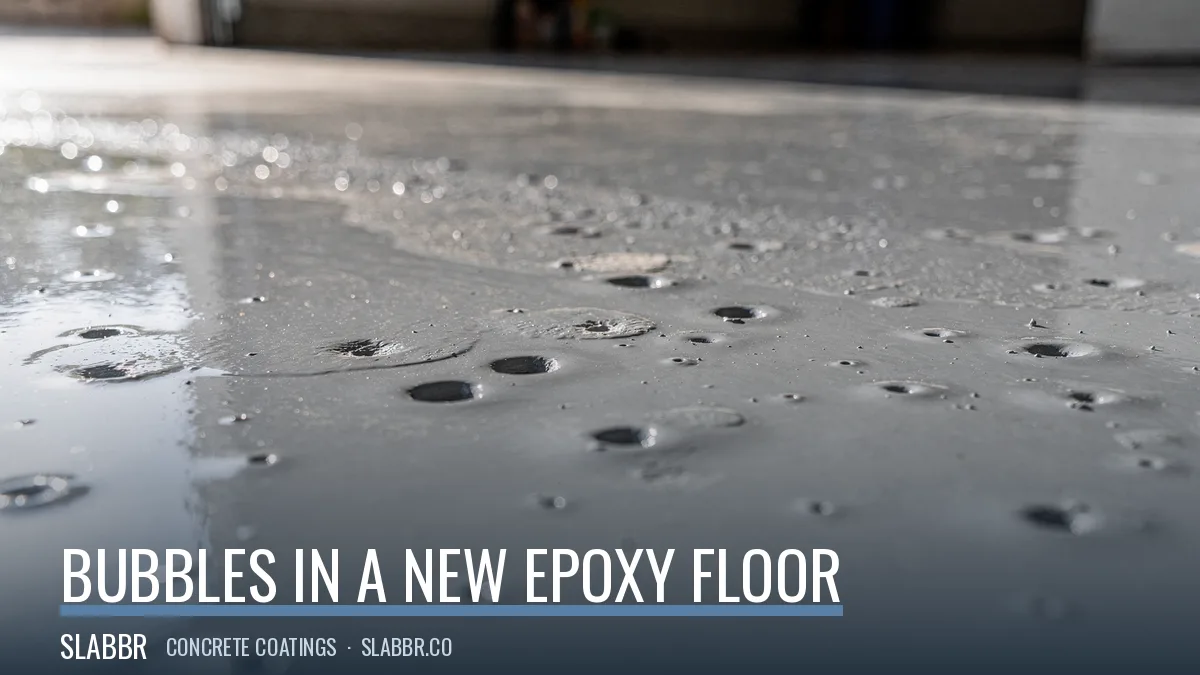
Bubbles in a new epoxy floor come from outgassing air or moisture vapor, and each needs a different fix. Popping a blister tells you which: dry craters mean air, liquid or white residue means moisture. Slabbr tests slab moisture before coating and installs a vapor barrier when readings demand it.
The two causes, and how to tell them apart
Bubbles in a new epoxy floor come from one of two sources: air escaping the concrete, called outgassing, or moisture vapor pushing up from below the slab. Concrete is porous, roughly like a hard sponge. When the slab warms, air in those pores expands, rises, and blows bubbles in wet epoxy. When ground moisture pushes vapor upward, it lifts the cured film into blisters instead.
You can usually tell them apart by size, timing, and what is inside. Outgassing bubbles are small, often pinholes or craters, and they appear while the coating is still wet or within hours. Moisture blisters tend to be larger, show up days or weeks later, and often hold liquid or leave a white mineral crust when they pop. Pop one and look before you decide anything.
Why the falling-temperature trick only fixes one cause
The most repeated advice online says to apply epoxy in the evening while slab temperatures are falling, and it works, but only for outgassing. Cooling air in the pores contracts instead of expanding, so it pulls the coating down rather than blowing through it. If your bubbles came from expanding air, timing the pour solves it. Applying in the morning as the slab heats up does the opposite.
Moisture does not care what time you pour. Vapor drive comes from ground water and humidity below the slab, and it pushes upward day and night. Recoat a moisture-driven floor in the evening and you get the same blisters on a different schedule. This is why the wrong diagnosis fails twice: the fix that cures outgassing does nothing for vapor, and homeowners often burn a second batch proving it.
Test the slab for moisture before anyone coats it
Moisture vapor drive is the top cause of coating delamination, so the moisture reading should happen before the coating, not after the failure. A calcium chloride test or a concrete moisture meter tells you how much vapor the slab is pushing. Slabs poured without a vapor barrier underneath read high more often. So do garages that sit downhill from irrigated lawns or pool decks.
A high reading does not mean you cannot coat the floor. It means the system needs a moisture vapor barrier coat designed to hold back that pressure before the color coat goes down. Slabbr's Prime build, its most installed system at $8 per square foot, includes that vapor barrier under a polyaspartic base for exactly this reason. Skipping the test is guessing with the whole budget.
What a pro does differently
A professional install controls both causes before the first drop of coating. Slabbr diamond grinds every slab with HEPA dust extraction, never acid etch, which opens the pores so trapped air and the base coat behave predictably. Cracks get repaired with rigid polymer so they cannot channel vapor straight to the surface. The moisture reading decides whether the vapor barrier coat goes down first.
Product choice matters as much as prep. A polyaspartic base coat wets into a ground surface and cures in a controlled window, and the flake broadcast to refusal plus topcoat build a film thick enough to resist pinholing. The whole system installs in one day. You walk on it in 24 hours and park in 72.
When a bubbled floor is salvageable
A floor with scattered pinholes from outgassing is usually salvageable. If the coating is bonded everywhere else, the surface can be sanded flat, the pinholes filled, and a topcoat applied over the sound film. This works when the bubbles are cosmetic and a screwdriver cannot lift the edge of the coating anywhere. Test the bond before you spend anything on the fix.
Moisture blisters usually mean removal. Once vapor has broken the bond, the film around each blister is compromised, and recoating traps the problem under a new layer. Slabbr removes failed coatings at $1.50 per square foot, about $660 on a 2-car garage, then treats the moisture and rebuilds the system. A free estimate with a moisture reading tells you which case you have before you commit.
Find out if it is air or moisture
Slabbr reads slab moisture before recommending anything, so you fix the actual cause instead of paying for the wrong repair twice. If the floor needs removal, that runs $1.50 per square foot, with the redo priced from a published rate sheet. The estimate is free, with no commissioned salespeople, a 50% deposit to book, and the balance due only when you walk the finished floor.
Related services
The floors behind this article
Related questions
- Do you grind the floor or acid etch it?
- How long before I can park on my new floor?
- What is hot tire pickup?
- Why is my epoxy garage floor turning yellow?
What we guarantee, in writing: the warranty. How install day runs: our process. The standards we prep to: ASTM and ICRI.
Straight answers, real numbers
Keep reading
See your number in about a minute
Pick what we are coating, pick the size, get a price. No home visit needed to see it and no salesperson attached to it.