
August 25, 2026
My epoxy floor is peeling after a year. Whose fault is it, and what are my options?
An epoxy floor peeling within a year failed from one of three causes: acid-etch prep instead of grinding, untested moisture pushing up through the slab, or straight epoxy softening under hot tires. The pattern tells you which. Slabbr removes failed coatings at $1.50 per square foot and rebuilds with a lifetime residential warranty.
Written by the Slabbr crew, installing concrete coatings across North Texas since 2019. About Slabbr
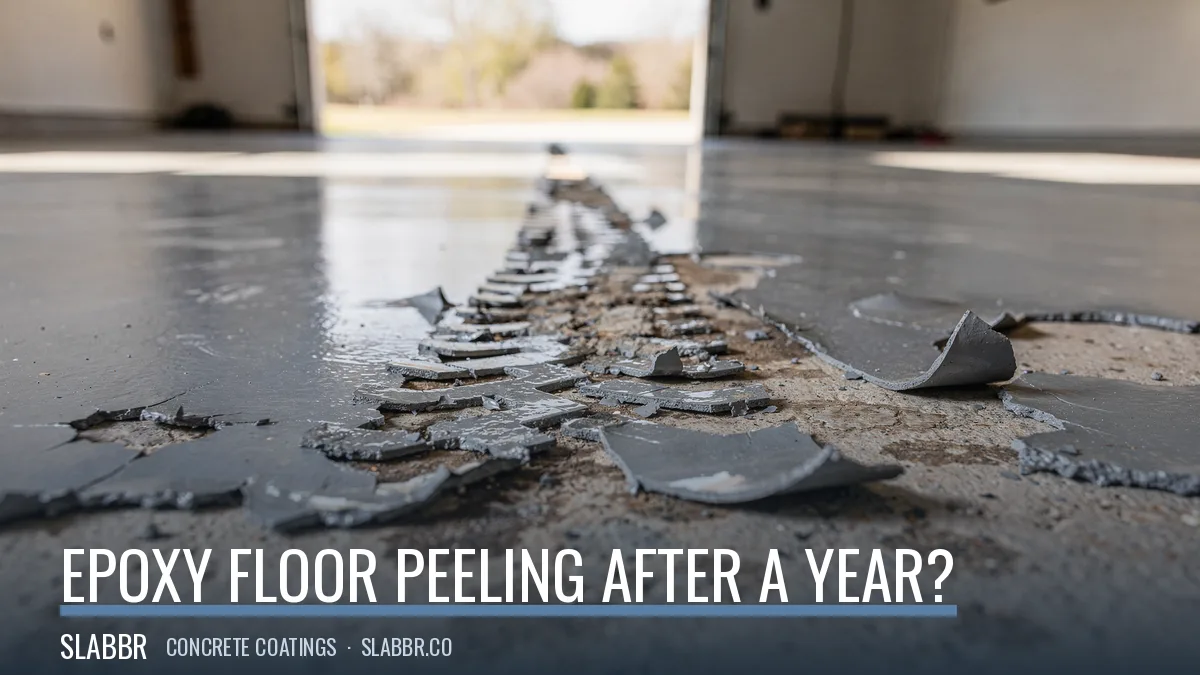
An epoxy floor peeling within a year failed from one of three causes: acid-etch prep instead of grinding, untested moisture pushing up through the slab, or straight epoxy softening under hot tires. The pattern tells you which. Slabbr removes failed coatings at $1.50 per square foot and rebuilds with a lifetime residential warranty.
First, read the failure pattern. It names the cause
A coating that peels inside a year did not wear out. It never bonded, and the pattern on your floor says why. Tread-shaped patches where the car parks are hot tire pickup: straight epoxy softened under tire heat and grabbed the rubber instead of the slab. That is a chemistry failure, the installer used the wrong wear layer for a Texas garage.
Sheets lifting at edges, cracks, or across whole sections point at prep or moisture. If the underside of a peeled piece is dusty and gray, the coating bonded to a weak surface layer that acid etching left behind. If the underside is damp, crusted white, or the slab beneath looks dark, moisture vapor pushed the film off from below. Pull a loose piece and look at its back before you call anyone.
Whose fault each cause is
Etch-only prep is the installer's fault, full stop. Mechanical grinding has been the professional standard for years because etching cannot open a machine-troweled slab or remove old sealers. An installer who skipped the grinder chose speed over your floor. The same goes for thin build: a coating stretched to cover more area than the material honestly covers fails in the traffic lanes first.
Moisture is shared ground, and this is where warranty fights live. The vapor was always in your slab, but a professional is supposed to test for it before coating and install a vapor barrier when readings demand it. An installer who never tested cannot blame the moisture he never measured. If your invoice shows no moisture reading, the failure to check was the failure.
Use the warranty before you spend a dollar
If a company installed the floor, put the claim in writing before paying anyone else to touch it. Email, not phone, with photos and the install date, and ask one direct question: is this failure covered, yes or no, and under which clause. A written denial naming the exclusion is worth having. User reports across the industry describe warranties denied for unregistered paperwork, moisture exclusions, and hot tire exclusions, which are the exact failures that actually happen.
Know what you are up against: many coating warranties exclude moisture and hot tire pickup, the two most common causes, and some evaporate when a franchise changes hands. If the denial cites an exclusion for the very thing that destroyed the floor, you have learned what that warranty was worth. It also tells you precisely what to demand from the next company: coverage that names those failures, attached to the job, no registration.
Your three options, cheapest to most honest
Spot repair is the cheapest and disappoints most. The peeled areas can be scraped, primed, and patched, but repairs rarely match color and the surrounding film failed the same prep, so new peeling starts at the patch borders. It buys a season, not a solution. A sand-and-topcoat works only when the failure is truly cosmetic and the rest of the film cannot be lifted anywhere with a screwdriver.
Removal and rebuild is the honest fix for a floor peeling in sheets or in the tire lanes. The failed coating comes off by diamond grinding back to bare concrete, the actual cause gets treated, moisture barrier, real prep, correct chemistry, and the new system goes down as if the first one never happened. It costs more today and less over any five-year window you care to measure.
What the fix costs at published rates
Slabbr removes a failed coating for $1.50 per square foot, about $660 on a 440 square foot 2-car garage, adding a half day to the job. The rebuild is published pricing: One at $6 per square foot, Prime at $8 with the moisture vapor barrier under the polyaspartic base, Ironclad at $10 with two polyaspartic topcoats. A complete removal-and-Prime rebuild on a 2-car garage lands near $4,180, installed in one day.
The second floor should be the last one. Every Slabbr build is diamond ground with HEPA extraction, moisture is read before coating, cracks are repaired with rigid polymer at no charge, and the wear layer is polyaspartic, which does not soften under hot tires or amber in sunlight. The lifetime residential warranty attaches to the job with no registration, and nothing is due until the floor is installed and you have walked it.
Get a floor that stays down
Send us photos of the peeling and your square footage, and you will get a straight answer on whether it is repairable or a removal job, priced from the published rate card before anyone visits. Call Burleson at (469) 849-8338 or Celina at (903) 243-9525. Free estimate, no commissioned salespeople, 50% deposit and the balance due only when you walk the finished floor.
Related services
The floors behind this article
Related questions
- How much does it cost to coat a 2-car garage floor?
- What is hot tire pickup?
- Why is my epoxy garage floor turning yellow?
- Can you coat over an existing epoxy floor?
What we guarantee, in writing: the warranty. How install day runs: our process. The standards we prep to: ASTM and ICRI.
Straight answers, real numbers
Keep reading
See your number in about a minute
Pick what we are coating, pick the size, get a price. No home visit needed to see it and no salesperson attached to it.