
August 31, 2026
What does a garage floor coating warranty actually cover?
Most garage floor coating warranties exclude moisture vapor, hot tire pickup and normal wear, then require a registration card the homeowner never mails. Slabbr writes a lifetime residential warranty that attaches to the job, with no registration and no transfer paperwork, so the coverage stays with the floor when the house sells.
Written by the Slabbr crew, installing concrete coatings across North Texas since 2019. About Slabbr
Most garage floor coating warranties exclude moisture vapor, hot tire pickup and normal wear, then require a registration card the homeowner never mails. Slabbr writes a lifetime residential warranty that attaches to the job, with no registration and no transfer paperwork, so the coverage stays with the floor when the house sells.
Lifetime covers the material, not your floor
Every quote in this category says lifetime somewhere. The word is doing less work than it looks. Warranties across the category typically split into two lines. The material carries a long term, sometimes lifetime, sometimes twenty five years. The labor carries a short term, and one year is common. Read that split out loud and it says something plain. If the coating fails in year three, the company may send a box of product, and you pay a crew to grind the old floor off and put the new one down. The long number sells the job. The short number is the one you live under.
The second split sits inside the covered failure list. Most warranties cover peeling and delamination, which is the coating letting go of the concrete. Staining coverage, where it exists, usually carries a wipe up window, and twenty minutes shows up as a real term in real warranty documents. Nobody wipes brake fluid within twenty minutes of a leak they have not noticed yet. So the covered list narrows to one failure mode, adhesion, and adhesion failure on a properly ground slab is the least likely thing to go wrong in a garage. The failures homeowners actually call about live in the exclusion list instead.
Hold that pattern in your head while you read any of these documents. The covered section is written around the failure that correct prep already prevents. The excluded section is written around the failures that slab condition and daily use actually produce. A warranty is not a statement about quality. It is a list of the repairs a company has agreed to pay for. Read the exclusions first, then read the coverage, and you will know within five minutes whether the paper means anything on your slab. Five exclusions do almost all of the work in this category, and every one of them names a failure that happens in real garages.
Exclusion one and two: moisture vapor and hot tires
Concrete moves water. A slab on grade in North Texas pushes vapor up through the pour every day of its life, and a coating on top of it is a lid. Warranties across the category typically exclude hydrostatic pressure and moisture vapor transmission above a stated number. One national brand publishes eight pounds as its ceiling in its public warranty. Others cite three or six pound MVER limits, or a Tramex relative humidity reading. Look at what that sentence does. Vapor drive is what blisters, bubbles and disbonds a garage coating, and the document excludes it by number. The exclusion is pointed straight at the most common failure on a residential slab.
The other half of the moisture problem is when the number gets taken. Industry reports describe crews discovering moisture after grinding starts on install day, then quoting mitigation on the spot with the truck already in the driveway. You either pay the add on or you accept a floor with a known exclusion built into it. Slabbr reads moisture before coating, not after the grinder is running, and the Prime build at eight dollars a square foot includes a moisture vapor barrier under the polyaspartic base. The reading happens during the estimate, so the number is a design input instead of a reason to decline a claim four years later.
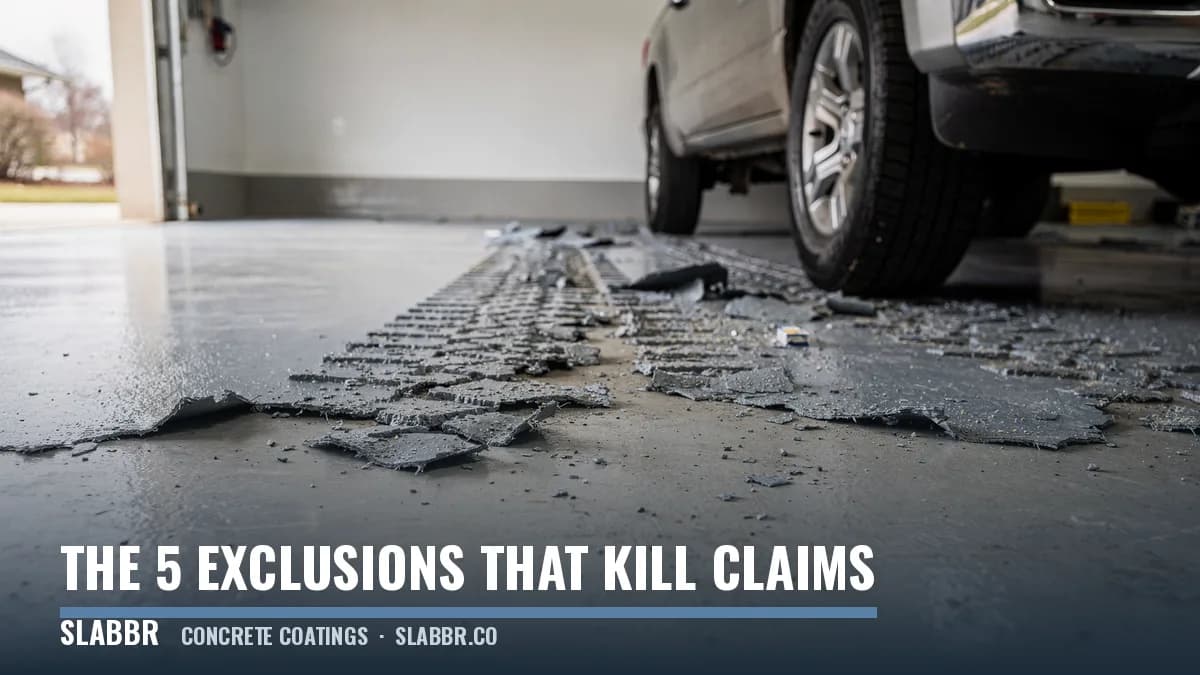
Hot tire pickup is the second exclusion that names a real failure. A tire heats on the drive home, softens the coating, cools, grips, and lifts a patch of finish when you back out. Thin epoxy and cheap one day systems do this most. Some warranties exclude tire marking and staining outright. Others advertise a hot tire guarantee, then define pickup as delamination only, which leaves the plasticizer stain, the yellowing and the dull tire shaped patch uncovered. Ask which definition is in their document, and ask the installer to put a finger on the sentence while you read it.
Exclusion three and four: the registration card and the company that closed
The third exclusion does not read like an exclusion. It reads like a chore. Register your warranty within thirty days. Keep receipts for maintenance. Schedule an annual inspection. Every one of those clauses is a condition, and a condition you missed is a claim the company can decline without ever looking at your floor. Nobody mails the card. Everybody assumes the installer filed it. Four years later the coating lifts and the first question on the phone is a registration number nobody has. That is not sloppy drafting. A condition most customers fail is a quiet way to shrink the number of claims that ever get paid.
The fourth is ownership. Warranty language commonly limits coverage to the owner of the property at the time of contracting, which means the day you sell, the paper is done. Some brands allow one transfer for a fee and a form that has to be filed inside a window. That matters at resale, because a floor with live coverage is a line in the listing and a floor without it is just a floor. Ask what happens to the warranty when the house changes hands, and get the answer out of the document rather than out of a conversation on your driveway.
Then ask who stands behind the paper. Much of this category runs on franchise and dealer models, and the warranty is backed by the local operator rather than the brand on the truck. If that operator closes, sells the territory, or drops the license, your claim goes to a number that does not ring, and the brand points at the franchise agreement. Slabbr writes a lifetime residential warranty that attaches to the job. No registration card, no transfer paperwork, no clock running on the labor. The Burleson and Celina shops are the same company that ground your slab and the same company that comes back.
Exclusion five: normal wear, and the questions that force a straight answer
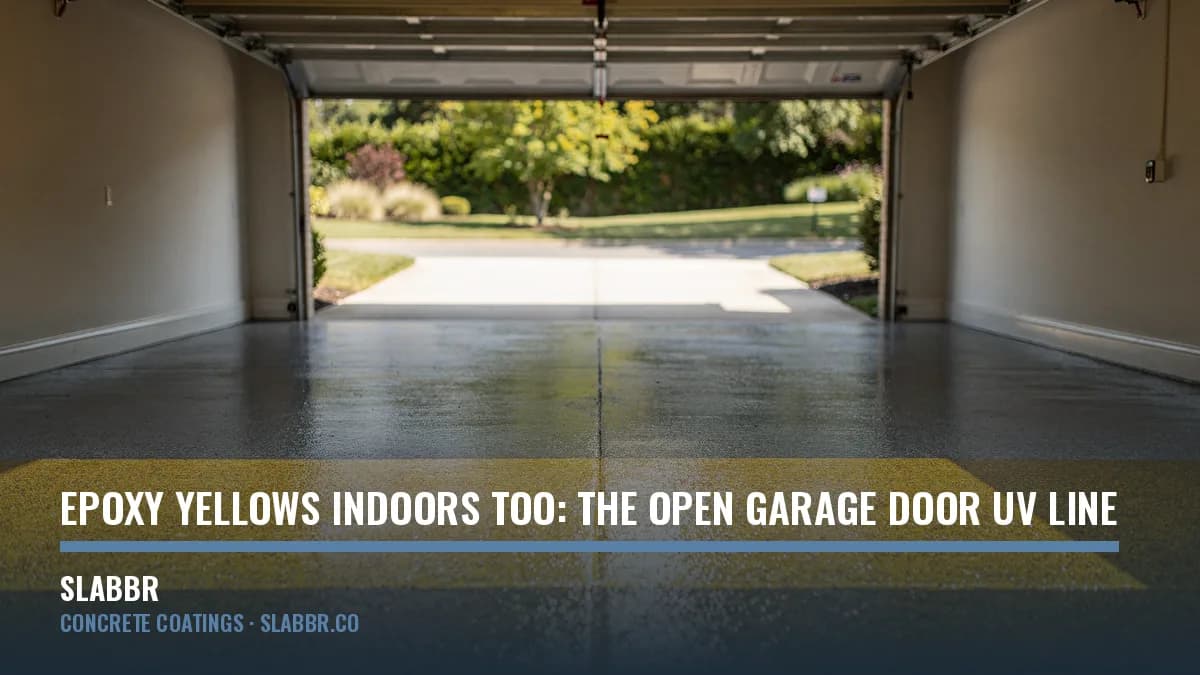
Normal wear and tear is the last exclusion and the widest one. It sits in nearly every document in the category and it is almost never defined. A dull traffic path from the door to the truck is wear. Scratches from a floor jack are wear. Fading in the bay that takes afternoon sun through an open door is wear. Once that phrase is in the contract without a definition, the company decides what it means on the day you file. Ask for a definition in writing before you sign. An installer who will define normal wear in one sentence is a different kind of company than one who will not.
Four questions get you most of the way. First, how long is labor covered, stated separately from the material, and who pays to grind off a failed coating. Second, what moisture number voids this warranty, and are you reading my slab before you quote it. Third, is hot tire pickup covered as delamination only, or does discoloration count. Fourth, if your location closes or sells, who honors this. Then ask for the complete warranty document before any money changes hands. A company that will not show you the exclusions until after the deposit has already told you what is in them.
Prep is the quiet condition behind all five. Coverage assumes the concrete was opened correctly, and acid etching does not open a hard troweled garage slab the way mechanical profiling does. Put a coating over an etched or pressure washed floor and adhesion failure becomes a prep failure, which lands under improper installation, misuse or substrate defect depending on which document you are holding. Slabbr diamond grinds with HEPA extraction on every job and never acid etches. Cracks get repaired with rigid polymer at no charge before anything goes down, because a crack telegraphing through new coating is another argument you should never have to have.
What it costs, and why the price is on the website
Here is what none of the pages ranking for this search will tell you. Not one of them publishes a price. Slabbr does. A standard two car garage is 440 square feet. The One build is $6 a square foot, which is $2,650. Prime is $8 a square foot, or $3,520, and that is the build with the moisture vapor barrier and the flexible polyaspartic base. Ironclad is $10 a square foot, or $4,400, full polyaspartic. The same lifetime residential warranty rides on all three. The build changes what goes on your slab, not what happens when you call about it later.
If you are replacing a coating that already failed, removal is $1.50 a square foot, about $660 on a two car garage, and it adds a half day to the schedule. That number is on the table before you decide anything, not discovered once the grinder is running. Install is one day. You walk the floor at 24 hours and park on it at 72. There is no travel premium anywhere in DFW and no commissioned salesperson, which is why the estimate is a measurement and a moisture reading instead of a closing pitch at your kitchen table.
Set that against a warranty conversation you are not allowed to have until after the deposit. A price you can read on a website is a term you can hold a company to. So is a warranty that attaches to the job with no card to mail and no form to file. When you collect quotes, put the dollar figures side by side, then put the exclusion lists side by side. Pick the pair you would still be comfortable with in year six, because year six is when you find out which document you actually bought.
Read the price and the warranty before you decide
Free estimate, no commissioned salespeople, no travel premium anywhere in DFW. You see the moisture reading, the build and the full warranty before anything gets scheduled, and nothing is due until the floor is installed and you have walked it. A 440 square foot two car garage runs $2,650 for One, $3,520 for Prime, $4,400 for Ironclad. Call Burleson at (469) 849-8338 or Celina at (903) 243-9525.
Related services
The floors behind this article
Related questions
- How much does it cost to coat a 2-car garage floor?
- What is hot tire pickup?
- Why is my epoxy garage floor turning yellow?
- Can you coat over an existing epoxy floor?
What we guarantee, in writing: the warranty. How install day runs: our process. The standards we prep to: ASTM and ICRI.
Straight answers, real numbers
Keep reading
See your number in about a minute
Pick what we are coating, pick the size, get a price. No home visit needed to see it and no salesperson attached to it.