
Guide
What is the best garage floor coating for Texas heat?
The best garage floor coating for Texas heat is a 100 percent polyaspartic system, not epoxy. Epoxy softens under hot tires and ambers in UV. Slabbr installs three flake systems built for North Texas from $6 per square foot, each polyaspartic from base coat to topcoat and backed by a lifetime residential warranty.
How hot a North Texas garage slab actually gets
Dallas Fort Worth air temperatures sit above 95 degrees for much of July and August, and a closed garage runs hotter than the yard. The slab soaks up that heat all day and holds it after sunset. Concrete works like a thermal battery. By late afternoon the floor under your car can be warmer than the air above it.
Your tires add more. After 20 minutes on a Texas highway, tire tread can pass 120 degrees. Park that tire on a slab that already sits at 90 plus degrees and the coating under the contact patch gets pinched between two heat sources for hours. That is the exact condition that separates coatings that last from coatings that fail.
Why straight epoxy fails in Texas garages
Straight epoxy softens as it heats, and North Texas gives it heat for 5 months a year. Epoxy resin has a lower heat tolerance than polyaspartic, so a hot slab plus hot tires pushes the coating past the point where it stays hard. Once it softens, it grabs the tire instead of resisting it.
Epoxy also ambers under UV light. The clear coat yellows first, then the whole floor takes on a dingy tint, worst in the strip near the garage door. Neither problem shows in the first month. Both show by the second summer, which is why so many Texas epoxy floors get quoted for replacement in year 2 or 3.
What hot tire pickup actually is
Hot tire pickup is a coating failure where hot tires soften the coating and lift it in tread-shaped patches when the car moves. You pull out of the garage and part of the floor goes with the tire. The patches match your tread pattern exactly, four rectangles, right where you park every night.
Two things cause it: a resin that softens at tire temperatures, and weak adhesion from poor prep. Paint and DIY epoxy kits fail on both counts. A tire also flexes and shrinks as it cools overnight, working at the coating edge like a slow pry bar. If the coating grips the concrete harder than it grips the tire, nothing moves.
UV comes through an open garage door
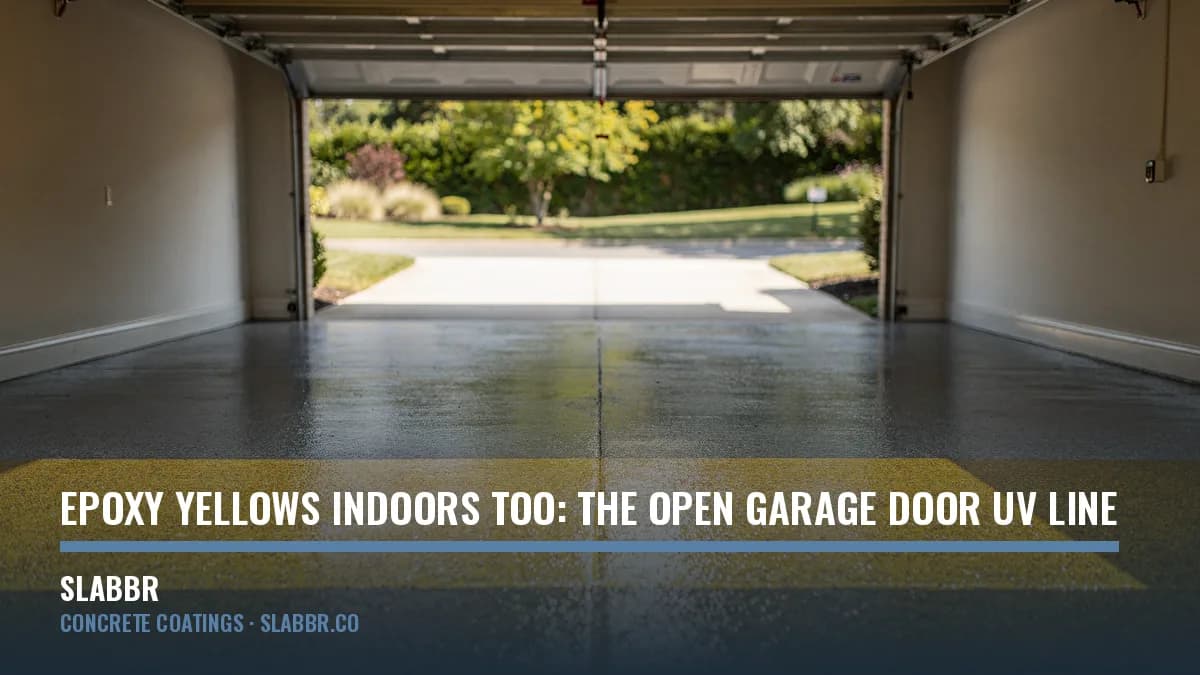
Your garage floor takes direct sun every time the door stands open, and the first 6 to 8 feet of slab take the most. That strip faces south or west on thousands of DFW homes, so it catches afternoon UV at full strength. An epoxy floor yellows there first and leaves a visible line where the sunlight stops.
Polyaspartic topcoats are aliphatic, which means UV-stable. They do not amber. That is why the topcoat matters as much as the base coat: the topcoat is the layer the sun and the tires actually touch. Every Slabbr system finishes with a polyaspartic topcoat for this reason, on all three builds, including the $6 one.
The right system stack for Texas
The stack that survives Texas is mechanical prep, a polyaspartic base coat, full flake, and a polyaspartic topcoat. Slabbr builds it 3 ways: Slabbr One at $6 per square foot, Slabbr Prime at $8 adding a moisture vapor barrier, and Slabbr Ironclad at $10 adding a second topcoat.
Every build includes diamond grinding, crack repair, flake broadcast to refusal, and a lifetime residential warranty. Slabbr Prime is the most installed because the vapor barrier handles ground moisture common under North Texas slabs and the polyaspartic base flexes with slab movement. Even the $6 build is polyaspartic in every layer, so nothing in the floor ambers or softens when the sun and the tires get to it.
How summer changes install day
Polyaspartic cures faster as slab temperature rises, so Slabbr schedules summer installs for early morning and mixes material in smaller batches. A batch that stays workable on a 70 degree spring slab can set up in minutes on a 95 degree August one. Racing a fast cure is how lap lines, thin spots, and trapped roller marks happen.
The timeline you follow does not change with the season. Walk on the floor at 24 hours, park at 72, and move your contents back the next day. What changes is the crew start time and batch size, which is a scheduling detail Slabbr handles, not a compromise you see in the finished floor.
The services behind this guide
Get the floor, not just the reading
Related questions
- How much does it cost to coat a 2-car garage floor?
- What is the difference between epoxy and polyaspartic?
- What is hot tire pickup?
- Why is my epoxy garage floor turning yellow?
What we guarantee, in writing: the warranty. How install day runs: our process. The standards we prep to: ASTM and ICRI.
Straight answers, real numbers
From the blog
See your number in about a minute
Pick what we are coating, pick the size, get a price. No home visit needed to see it and no salesperson attached to it.