
Guide
Polyaspartic vs Epoxy: Which Garage Floor Coating Is Better in Texas Heat?
Polyaspartic beats epoxy on UV stability, elongation, hot tire resistance, and cure speed. Epoxy ambers in sunlight, cracks when the slab moves, and needs most of a week before you can park on it. That is why Slabbr installs only 100 percent polyaspartic systems, at $6 to $10 per square foot.
The Chemistry Difference in Plain Words
Epoxy and polyaspartic are different resins that cure in different ways, and everything else in this comparison flows from that. Epoxy is a two-part resin that cures slowly through a chemical reaction, building a thick, hard, glass-like layer that bonds deeply into properly ground concrete. It has been the garage standard for decades because it is affordable and it works indoors.
Polyaspartic is a newer chemistry. It cures fast, stretches instead of cracking when the slab moves, and its structure does not break down in sunlight. Think of epoxy as hard, slow, and sun-shy. Think of polyaspartic as hard, fast, and sun-proof. On a moving North Texas slab under a Texas sun, that is not a close call, which is why we install one and not the other.
Cure Time: Hours Versus Most of a Week
Straight epoxy takes 5 to 7 days to cure hard enough for vehicle traffic, while polyaspartic cures in hours. That single fact decides most garage projects. A week without parking in your own garage is a real cost in North Texas, where spring hail makes the driveway an expensive place to leave a car.
A full polyaspartic system compresses the whole timeline. Slabbr installs most 2 and 3-car garages in one day. You walk on the floor at 24 hours, your garage contents go back the next day, and you park at 72 hours. That 72-hour parking window is us being conservative with your warranty, not the chemistry struggling to keep up.
UV Yellowing and Hot Tire Pickup
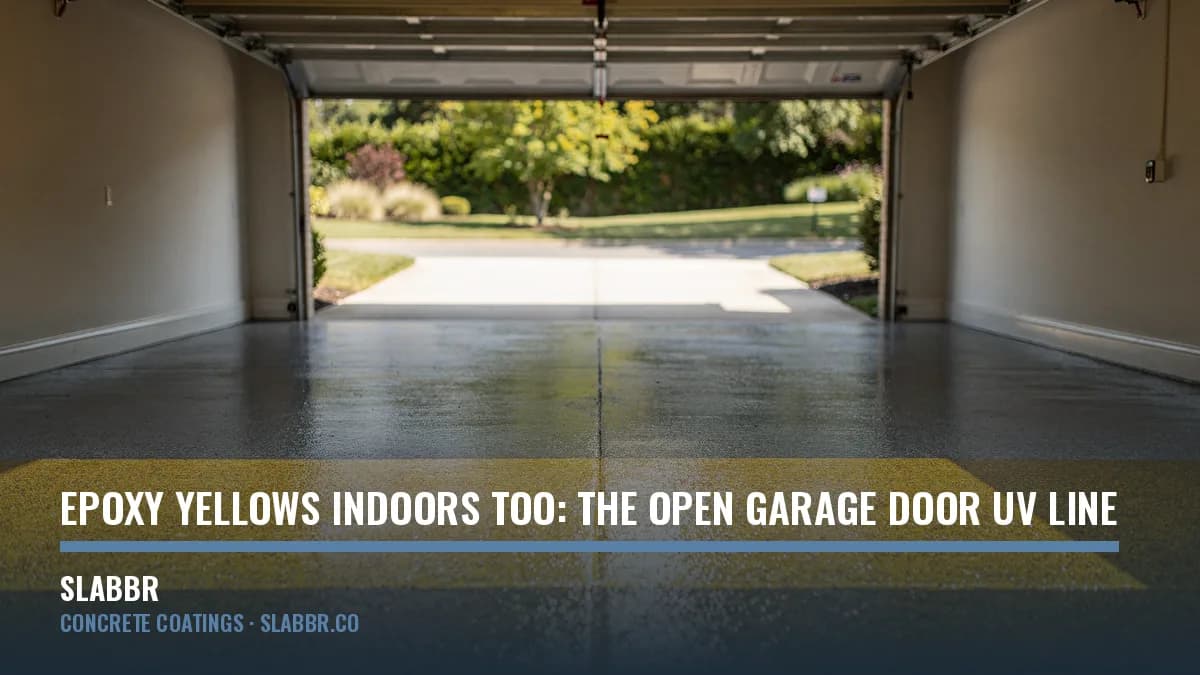
Epoxy ambers under UV light and softens under hot tires, and Texas supplies plenty of both. An epoxy floor near a sun-facing door yellows unevenly over time. Worse, summer tires come home hot, and softened epoxy under a hot tire can peel up in the tire's footprint when you back out. Installers call it hot tire pickup, and it is the top failure mode for thin epoxy floors.
Polyaspartic is UV stable and hot-tire resistant. It does not yellow in sunlight and it stays hard under tire heat. This is why every Slabbr build, including the $6 Slabbr One, is polyaspartic in every layer. The surface that actually meets your tires and the sun is the chemistry built to survive them, and so is everything underneath it.
What the Cost Difference Buys
All three Slabbr builds are polyaspartic top to bottom, and the $2 to $4 per square foot between them buys layers, not a chemistry downgrade. Slabbr One is $6 per square foot with a polyaspartic base, flake to refusal, and one topcoat. Slabbr Prime adds a moisture vapor barrier at $8. Slabbr Ironclad adds a second topcoat at $10. On a 440 square foot 2-car garage, that is $2,650 versus $3,520 versus $4,400.
You are paying for protection where it counts. The moisture vapor barrier in Prime stops the vapor drive that is the top reason coatings let go. The second topcoat in Ironclad builds a wear layer thick enough for shops and lifts. All three carry the same lifetime residential warranty, so the upgrade question is about moisture protection and build thickness, not coverage.
Where Epoxy Still Gets Sold, and Why We Stopped
The usual defense of epoxy is that it works as a base coat, buried under flake and a UV-stable topcoat where sun and tires never reach it. We ran that experiment and stopped. A hidden epoxy base still cures slowly, still blushes when humidity turns on install day, and still cracks when North Texas clay moves the slab. When a base coat fails, the topcoat above it comes along.
Epoxy hangs on in this market because it is cheap for the installer, not because it is better for the floor. Our answer at the same prices is polyaspartic in every layer: solid color at $6 per square foot for workshops, storage rooms, and laundry rooms, and commercial systems at $4 to $12 for warehouses. Same budgets, none of epoxy's failure modes.
The Hybrid Build Nobody Names, and the Verdict
Most floors sold as one-day polyaspartic floors are actually hybrids: an epoxy base or a fast-set polyurea base under a polyaspartic topcoat. Companies rarely say so. The epoxy version hides a slow, rigid, moisture-sensitive layer under a premium label. The fast-set polyurea version has a different problem: a working time of roughly 5 to 20 minutes, which forces rushed prep and makes it hard to broadcast flake to full refusal before the base sets. Hybrids compress the installer's schedule. They do not improve your floor.
The verdict for a Texas garage: every layer should be polyaspartic, not just the one you can see. That is the only way Slabbr builds a floor. Ask any bidder to put their base coat chemistry in writing, and if the answer is epoxy or fast-set polyurea, ask what it does for your floor rather than for their calendar. If your slab shows moisture or you want maximum build, choose Prime or Ironclad. If budget rules, Slabbr One is the same chemistry with fewer layers, not a lesser one.
The services behind this guide
Get the floor, not just the reading
Related questions
- What is the difference between epoxy and polyaspartic?
- How long before I can park on my new floor?
- Why is my epoxy garage floor turning yellow?
What we guarantee, in writing: the warranty. How install day runs: our process. The standards we prep to: ASTM and ICRI.
Straight answers, real numbers
From the blog
See your number in about a minute
Pick what we are coating, pick the size, get a price. No home visit needed to see it and no salesperson attached to it.